After talking for months about his desire to eliminate school trustee positions, Ontario Education Minister Paul Calandra is preparing to introduce a bill. This will be only the latest in a series of upheavals in school governance since he took office a year ago.
A few weeks before the nomination period for school elections, the minister was evasive about the future of school trustee positions.
We will publish new legislation as soon as we return to the House […] and I think there will be a big update
he said during a press scrum on April 2.
But this reform is still pending: the deputies spent the following week in their constituency. They return to the Chamber on the 13th.
School groups and opposition parties accuse the government of underfunding education.
Paul Calandra instead points the finger at school boards and their governance model dépassé
for problems in schools.
Moreover, he has already imposed a series of changes and increased personal interventions with school boards.
March 2025: Paul Calandra is sworn in as Minister of Education
His former portfolio (Housing and Municipal Affairs) is transferred to Rob Flack.
Shortly after taking office, Paul Calandra raised concerns about the spending of certain school boards.
April 2025: a first school board is placed under supervision
The minister places the Thames Valley District School Board (TVSDB), in the south-west of the province, under supervision.
From this point on, decisions that usually fall to school counselors are instead made by a supervisor appointed by the province.
Paul Calandra intervened at the recommendation of the PwC firm, which had been hired to produce a report on the problems of this school board.
The TVDSB had been running a deficit for several years. However, council executives took part in a $40,000 retreat at the former SkyDome hotel in Toronto in August 2024.
May 2025: tabling of a bill to increase the powers of the minister
The Minister of Education tables Bill 33 at Queen’s Park.
This measure is intended to allow the minister to take control of problem school boards more easily and for a wider range of reasons.
He will be able to investigate councils for any reason in the public interest, not just financial ones. The investigation may also be conducted by departmental auditors instead of independent examiners.
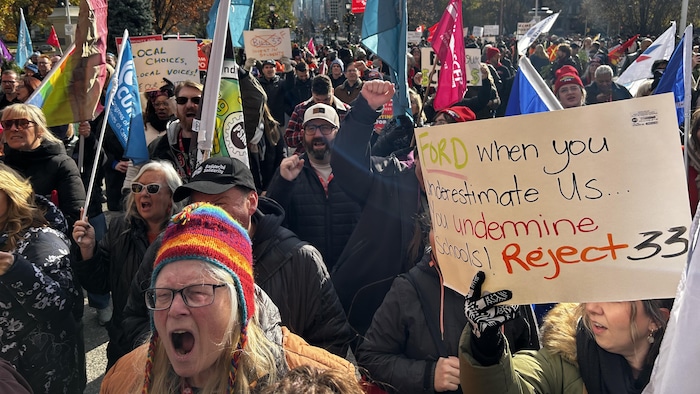
A few hundred people took part in a demonstration in front of Queen’s Park, to denounce the adoption of Bill 33 which gives more power to the Minister of Education Paul Calendra (November 2025).
Photo : Radio-Canada / Marion Bérubé
This bill gives the minister a veto over the names of schools.
In addition, it requires school boards to collaborate with police services to participate in the controversial school officer program.
June 2025: four other school boards placed under supervision
Four more school boards are placed under supervision for financial reasons, including the Toronto English Public School Board (TDSB).
The minister appoints supervisors who will have the task of straightening out the finances of four organizations.
All school boards in the province are being warned – even those with surpluses: if decision-making does not prioritize the success of students and resources for teachers, I will not hesitate to intervene.
August 2025: the minister discusses a possible abolition of school counselor positions
In an interview with CBC, Paul Calandra indicates that his goal is to improve the quality of service in schools.
If it means eliminating school counselors, then I’ll do it
at-il déclaré.
He assures that the province will nevertheless respect the constitutional protections enjoyed by French-speaking and Catholic school boards.
November 2025: Bill 33 is adopted
Teachers’ unions, Franco-Ontarian organizations and opposition parties have stepped up their public outings against Bill 33 since it was introduced.
They denounce what they consider to be interference by the Minister of Education in matters usually managed by democratically elected advisers.
Francophones are particularly concerned that the minister’s increased powers endanger their right to a school system entirely managed by Francophones.
However, the government repeatedly assures that it will respect the constitutional rights of Francophones and Catholics.
A section of the law also specifies that all powers exercised by the minister must be compatible with linguistic or cultural aspects of French-language district school boards
.
Despite criticism, the bill was adopted under gag order and received royal assent on November 20.
The government also ordered all school boards to create help desks
to respond to parents who have concerns that they would normally raise with their school counselor.
December 2025: a school board placed under supervision thanks to the new law
Only a few days later, the minister used his increased powers to place a sixth school board under supervision.
The English public school board Near Northbased in North Bay, was targeted not for financial reasons, but because of a deep dysfunction and poor management
.
The council was put under investigation after major delays in opening a new school.
Paul Calandra announces that he himself will assume the role of supervisor for this board while waiting to appoint another one.
He will ultimately choose to keep the role.

There are 72 school boards in Ontario. Eight were placed under supervision by the province over the past year.
Photo : Radio-Canada / Ben Nelms
January 2026: a 7th council supervised by the province
The public school board of the Peel region is in turn placed under provincial supervision on an interim basis.
This council, in budget deficit, planned to lay off 60 teachers, which would have caused significant disruption to learning for nearly 1,400 students
according to a press release from the Ministry of Education.
The growing number of school boards under supervision is of particular concern to the Canadian Civil Liberties Association.
When governments exclude the voices of local elected officials, they undermine democratic principles, destabilize education systems and silence the communities that schools are meant to serve.
she wrote in a press release a few weeks later.
March 2026: a letter from the minister causes controversy
The York English Catholic school board was also placed under supervision on March 5, in particular because of its financial difficulties. At the same time, the government confirms that it has appointed a supervisor for Peel council.
Two weeks later, Paul Calandra again attracted the wrath of the opposition, this time for directives concerning school graduation ceremonies.
In a letter sent to school boards, he indicates that now is not the time for organizers to discuss any controversial or divisive issues
.
It requires councils to review their protocols to ensure these events are apolitical and strictly student focused
.
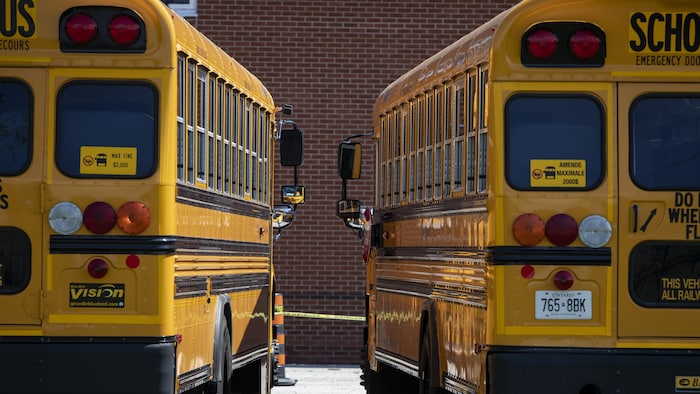
Critics accuse Minister Calandra of micromanaging schools and school boards.
Photo : Radio-Canada / Evan Mitsui
The minister specifies that if these directives are not respected, he will not hesitate to use all the tools at his disposal under the Education Act.
Opposition parties have accused the government of seeking to stifle its criticism, on the heels of Bill 33 and cuts to student loans and grants.
La cheffe néodémocrate Marit Stiles a qualifié la missive insulting
during the question period on March 25.
Our classes don’t need political interference from this minister, they need teaching assistants!
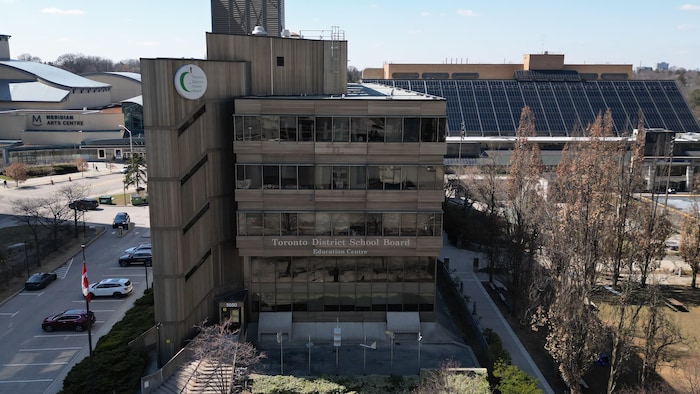
The Toronto English Public School Board (TDSB) offices in North York.
Photo : Radio-Canada / Patrick Morrell
April 2026: job cuts at TDSB
At the April 2 press scrum, Paul Calandra said he believed provincially supervised boards were now on the right path.
The TDSBand frankly, all supervised councils are doing what they have to do to get back on track and we are seeing the results
at-il déclaré.
The TDSBwhich is the largest school board in the country, had just announced the elimination of 40 assistant principal positions in its schools.
The minister estimates that there will be 5,000 fewer registrations in this school board next year, which partly justifies this decision.
A few days later, the TDSB revealed it also expected to cut around 289 teaching positions in its primary and secondary schools.
The local section of the union representing primary school teachers said it was taken by surprise by this announcement.
These cuts will increase the number of students per class and eliminate student support, while parents hear only silence from the overpaid and underqualified supervisor chosen by the Conservatives.
a dénoncé la néodémocrate Jessica Bell dans un communiqué.