As politicians warn against a potential attack on Iran by the United States, the White House remains confident in President Donald Trump’s ability to handle the aftermath of such a strike. This confidence reflects a pattern that has shaped Trump’s thinking for years. The foreign policy establishment in Washington advises the president against certain actions that violate norms. He disregards their advice and continues. And he faces no apparent repercussions. In 2018, when Trump broke from American policy by moving the US embassy to Jerusalem, I was working in the State Department’s Bureau of Near Eastern Affairs. Our own bureaucratic experts had predicted that this decision would lead to widespread protests and violence against American personnel, and we had set up task forces and evacuation plans in anticipation of a catastrophic scenario that never materialized. This scenario repeated itself last June, when Trump joined Israeli strikes against Iran’s nuclear program. Analysts had warned that this decision would trigger a broader war and accelerate Iran’s nuclear arms race. Once again, very little happened. When the administration ousted Venezuelan President Nicolás Maduro in January, experts insisted that his country, even the entire region, would descend into chaos, but nothing of the sort has occurred so far.
Source: Foreign Affairs, Nate Swanson
Translated by readers of Les-Crises website
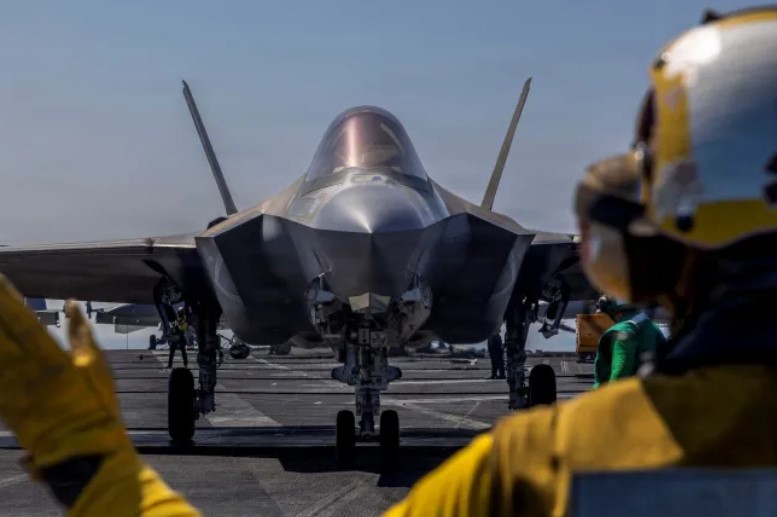
- A US Navy F-35 fighter jet taking off from an American aircraft carrier in the Gulf of Oman, February 2026 [Image Source: US Navy / Reuters]
It is easy to understand why Trump might think that warnings about a new attack on Iran are exaggerated and that he can repeat his formula of taking decisive action followed by a clear withdrawal. But this time, the situation is different. With 18 years of experience working on Iran in various government positions, including as director for Iran under President Joe Biden and within Trump’s negotiation team in the spring and summer of 2025, I see that Trump simply fails to grasp that Iran’s weakness will not lead to the country surrendering at the negotiation table. On the contrary, Iran’s current fragility only reduces the room for significant compromises. Trump also fails to realize that Iran is facing very different conditions than in June 2025 when he chose to de-escalate the conflict. The Islamic Republic now believes that Israel and the US intend to strike repeatedly at its ballistic missile program—the foundation of Iran’s self-defense—and that it must be more aggressive to prevent the kind of ongoing assault that could overthrow it entirely.
Trump’s behavior also increases the risk of escalation. The president’s increasingly urgent desire to appear as a historical peacemaker has led to an unnecessarily Manichean choice: either compel Tehran to enter into a new major agreement or resort to considerable force. The ambiguity surrounding his motivations makes this friction point even more dangerous. Trump seems to want to, without a specific order, showcase the power of the US military, strengthen his position in negotiations, show that he was serious when he pledged in a January message on Truth Social to protect Iranian protesters, and distinguish himself from President Barack Obama’s approach. This hodgepodge of objectives contrasts with the focus he displayed in his previous successful operations and makes him less prepared if a strike does not lead to the quick capitulation he expects. Ultimately, current conditions mean that a US attack on Iran could lead to unforeseen retaliatory violence and a much longer and potentially litigious conflict for Washington.
A Trap He Has Set for Himself
Strategically, Trump has no valid reason to attack Iran. Tehran certainly poses a threat to Washington’s interests in the Middle East, but it is not an immediate danger to the US. Following massive Iranian protests and the brutal crackdown that ensued, sustained economic and diplomatic pressure could have further weakened the regime without risking open conflict. However, this president rarely settles for discreet victories. He has therefore come up with a major and more spectacular demand. Either the Iranian government accepts a comprehensive nuclear deal in which it gives up all uranium enrichment and its missile program, or Washington attacks.
Launching a limited military strike against Iran to force compliance with American demands fits Trump’s modus operandi. It would provide a spectacle. And he clearly wants either a capitulation pact or a broader framework that validates his claim of bringing peace to the Middle East for the first time in millennia. But Iranian leaders are increasingly unwilling to offer him a major symbolic victory. Generally, Iranian negotiators prefer to focus on details and narrow concessions, tit for tat. Biden understood this, and as a member of his Iran negotiation team, I spent countless hours contemplating how to categorize nuclear-linked sanctions.
In a round of negotiations with the US in Geneva last week, Iran showed up with Foreign Minister Abbas Araghchi, all of its official advisers, and a team of technical experts to iron out specific details, such as how Iran would export its uranium stocks and which presidential decrees would be annulled. Trump, on the other hand, sent only two people: his versatile special envoy, Steve Witkoff, and his son-in-law Jared Kushner. He does not care about technical details and fails to grasp their particular importance to Iran.