In the field of energy, every national decision has continental repercussions. The closure of nuclear power plants in Germany and Belgium is a striking example: their maintenance would have profoundly altered the economic and climatic balance of the European electricity system.
The March 2026 publication, “Cross Border Impacts of Nuclear Phase-Out Policies on the European Power System: Economic and Environmental Insights for Strategic Energy Planning,” explores the consequences of closing nuclear power plants in Germany and Belgium. Not only on their national electrical systems but also on the entire European network.
Published in Energy Strategy Reviews, this analysis reveals how each energy decision can resonate beyond borders and influence the economy and environment of the Old Continent. To assess these impacts, the authors rely on a counterfactual scenario: they assume that reactors with an 8 GW capacity still in operation in 2022 would be kept active until 2030.
5% Emission Reduction Loss by 2030
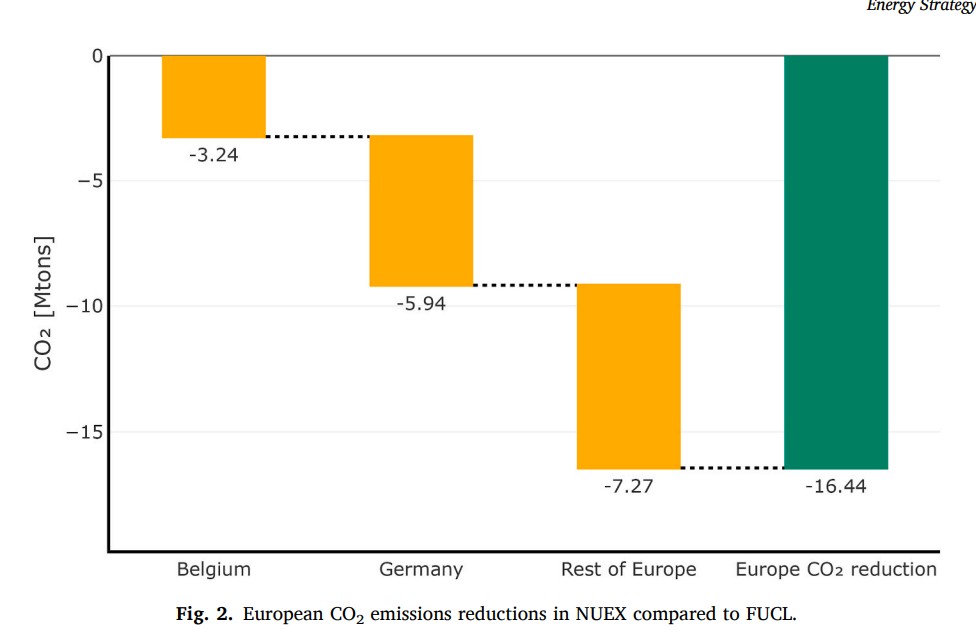
Nuclear energy helps limit the use of gas and coal power plants, which emit greenhouse gases, in the electricity mix. “CO2 emissions from the European electricity system would be reduced by 16.4 million tonnes per year in 2030, which is 5% less in the counterfactual scenario compared to the current situation,” the publication states.
Prolonging the operating life would have allowed Germany and Belgium alone to reduce emissions by 9.2 million tonnes, which corresponds to “56% of the total reduction of European emissions” in the counterfactual scenario. The remaining 44% is distributed throughout Europe due to cross-border effects. Countries with a heavily carbon energy mix reduce their CO2 emissions because they access “cheaper and low-carbon electricity imports.”
A Winning Economic Dynamic
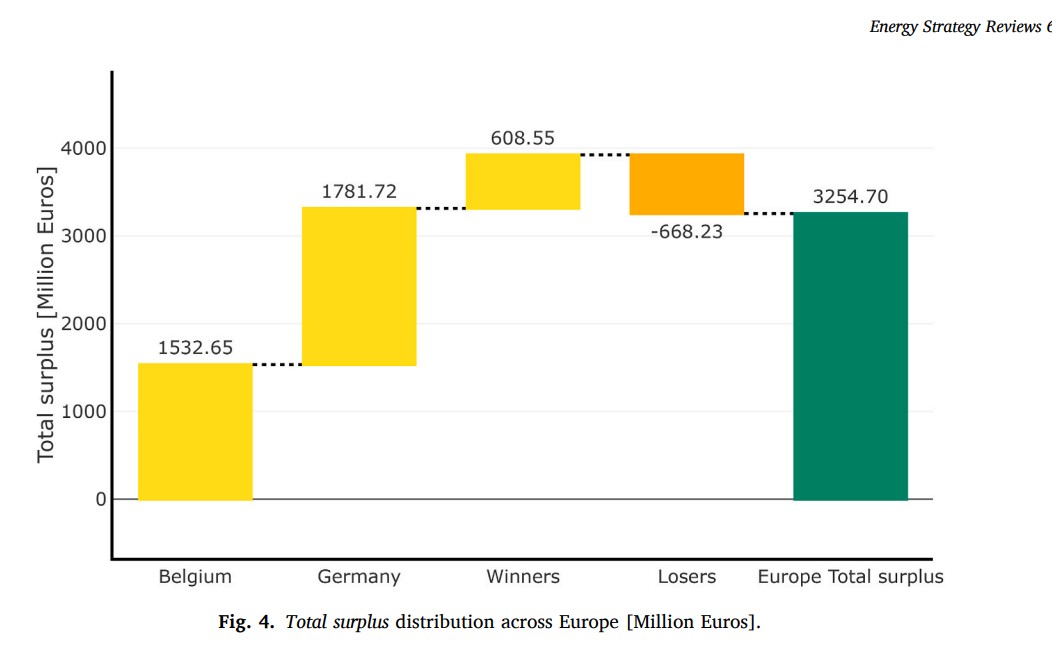
“There is generally a direct positive correlation between reducing CO2 emissions and decreasing operational costs,” state the publication’s authors. The OECD confirmed this in the 2019 report “The Cost of Decarbonisation”: “Variable costs gradually decrease as we transition from a low-carbon system dominated by nuclear energy.” This study supports this, showing that maintaining 4 GW of nuclear capacity in each country leads to an annual gain of 1.5 billion euros for Belgium and 1.8 billion euros for Germany. In total, extending 8 GW of nuclear capacity enables an economic gain of 3.09 billion euros in Europe.
The impact varies by country. With the maintenance of nuclear and renewable energy capacity, net electricity exporting countries like France and Denmark see their export volumes and energy prices decrease. For these nations producing electricity competitively, the shutdown of reactors in Belgium and Germany is economically favorable. Conversely, net importing countries like Poland and Italy benefit from the extension of nuclear capacity, as they “benefit from the additional supply of controllable energy at lower cost,” reducing their expenses and increasing their total surplus.
Maintaining nuclear power plants in Belgium and Germany would have been beneficial for the climate and economy, both for these two countries and more broadly for the European Union. The effects of energy policies adopted by a nation do not limit to that nation; they influence the entire continent. “Due to the interdependence of the electrical systems of European countries, political decisions and energy mix choices in one country have an impact on other countries,” warn the authors of this study.