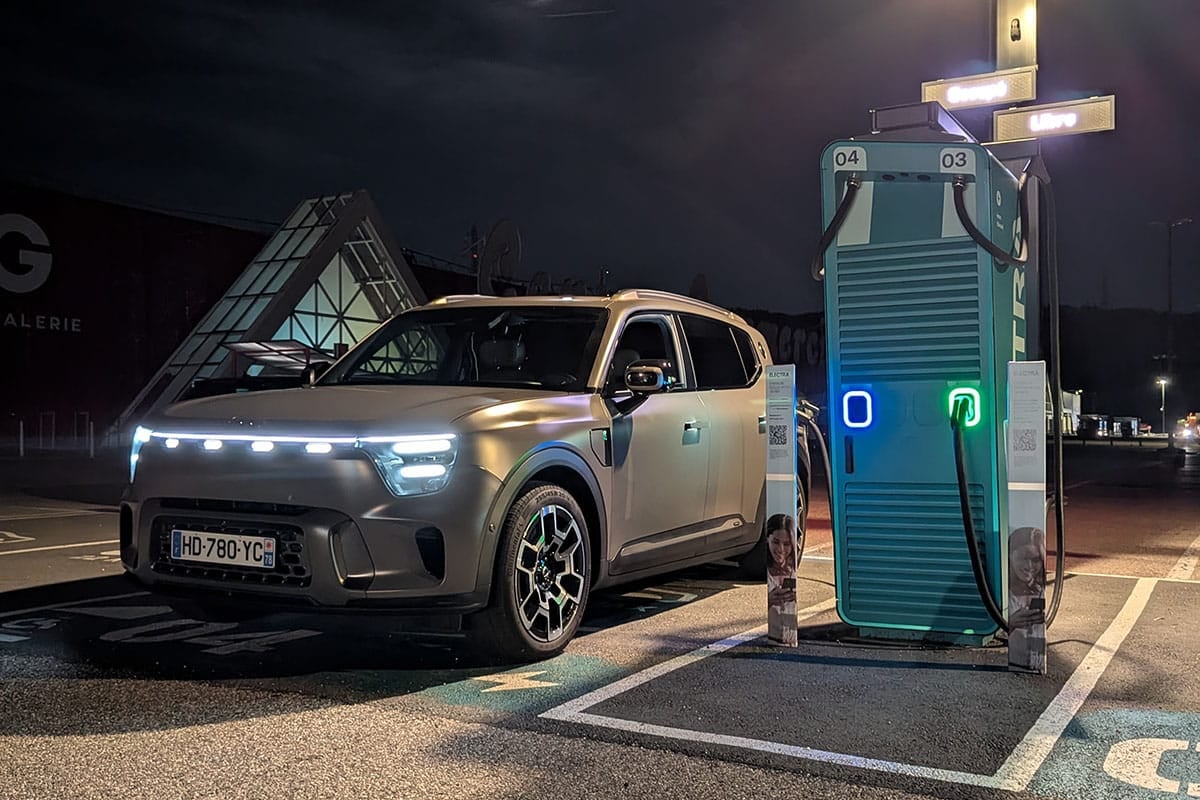
The Smart #5 intends to stand out in the electric car segment. To its impressive build, it adds impressive fast charging power.
The Smart #5 no longer has anything to do with the frail Fortwo that we regularly encounter in town. Its stretched dimensions allow it to offer a very generous living space for the family. On the other hand, this is not without effect in terms of energy. Its measurements and weight lead to significant overconsumption. To make up for this defect, it arrives with a gigantic battery of 94 kWh of useful capacity, and charging power at the very top of the basket.
Smart #5 Summit Edition: reminder of our measures
Last week we published the first part of this Supertest. Here is a very brief reminder of the numbers:
- Autonomies WLTP: 540 km
- Consommation WLTP: 19.9 kWh/100 km (17.4 kWh/100 km net)
- Mixed route: 21.3 kWh/100 km – 440 km
- Long range : 27.5 kWh/100 km – 340 km
Smart #5 recharge curve: 10-80% in 15 minutes
On paper, the Smart #5 can absorb a maximum power of 400 kW for a charging time announced in 18 minutes. Understandable caution on the part of the manufacturer, as factors can influence the recharge time. On the other hand, when all the planets are aligned, the Chinese SUV corrects the overwhelming majority of electric cars.
So, we clocked the 10-80% in just 15 minutes on a 400 kW Electra-Alpitronic terminal! A great time, which places it just behind the XPeng G6 and tied with the Lotus Emeya S. On the other hand, due to the quantities delivered, the others keep the advantage with an average power of 302 and 292 kW respectively, against 282 kW for the Smart #5. An Audi Q6 e-tron, which is not lazy on the fast terminals, maxes out at … 196 kW.
| 10 Ã 80Â % | Â 80 Ã 100Â % | Â 10 Ã 100Â % | |
| Cooldown time (in mins) | 15 | 15 | 30 |
| Range gained (in km) | 239 | 68 | 308 |
After 80%, where the residual power of 195 kW is absolutely remarkable, the Smart #5 requires 4 minutes to reach 90%, then 11 minutes to fully refuel. In the end, half an hour is enough to get back to 100%. To date, the SUV is the fastest electric vehicle measured by our services to fully refuel. And all in cathedral silence: when other so-called 800 V cars turn the fans on full blast to eliminate calories, the Smart #5 only emits a slight hiss. The technical performance is truly impressive!
Des Supercharger Tesla à éviter !
As always, these cars which can achieve high rapid charging powers are sensitive to different factors. And this is especially the case with the charging infrastructure, which does not always keep up. Thus, on this same 400 kW terminal, the SUV presented a completely different charging curve a second time despite identical weather and preparation conditions (motorway driving + battery preheating completed). Here, the power did not exceed 325 kW but was maintained for longer. But in the end, the 10-80% was achieved in 15 minutes and 15 seconds. On an Engie-Siemens terminal limited to 300 kW, it takes 17 minutes to complete the same exercise. In the case of a 175 kW terminal, 24 minutes of downtime will be necessary.
Finally, Smart #5 is not fond of 400 V Tesla Superchargers due to its higher operating voltage. To enable refueling at these terminals, it has a converter which limits the power to only 68 kW. From then on, the 10-80% is endless with this gigantic battery: the 10-80% here requires 57 minutes! The Tesla terminals should therefore be forgotten with this car!
Autonomie récupérée : 301 km en 30 minutes
On our exclusively motorway route of 500 km between Lyon and Paris, we recorded an appetite of 27.5 kWh/100 km, for a theoretical total autonomy of almost 340 km. On this basis, and considering the best fast charging curve of Smart #5, the SUV can regain 240 km of autonomy in just 15 minutes, and leave with 310 km in 30 minutes. If he lost to the Porsche Taycan Propulsion in the first time, he passed behind the Audi A6 Avant e-tron and Lucid Air Grand Touring during a normal break on the motorway. Among SUVs, it is just behind the XPeng G6 Performance (260 km in 15 minutes).
Cost of Smart #5 recharges
If the performance of fast charging is about average (7% difference between the quantity charged by the terminal and the theoretical quantity of the battery), the gargantuan consumption causes the cost of use to skyrocket. At an average public price of €0.59/kWh on fast charging stations, the cost of use on motorways stabilizes at €17.4/100 km. In mixed use, the cost does not fall below €13.5/100 km. You will have to consider taking out a subscription to reduce the recharge budget. In the case of recharging with alternating current at a maximum power of 22 kW (10-100% in 3 hours 53 minutes), the combined cost increases to €10.8/100 km. Finally, the Smart #5 will not cost much less than €5/100 km on a mixed route and with charging at home.
| Full price (10 to 80%) | Mixed journey cost | Highway cost | |
| AC à domicile (0,195 €/kWh) | 14,5 € | 4,7 €/100 km | 6,1 €/100 km |
| DC on public terminals (0.39 €/kWh) | 27,5 € | 8,9 €/100 km | 11,5 €/100 km |
| DC on public terminals (0.59 €/kWh) | 41,5 € | 13,5 €/100 km | 17,4 €/100 km |
Travel time for 500 km: 4h36
At the start of our 500 km journey, the Smart #5’s onboard planner offers us a single refueling point 300 km from our starting point, at the Maison-Dieu area, with a refueling time of 13 minutes and a travel time of 4 hours 33 minutes in total.
In reality, we were able to reach the next Engie station (300 kW max.), in the Venoy area, with 10% charge remaining in the battery. A stop of only 12 minutes was necessary to reach 65% and continue our journey to Paris, with 20% remaining in the battery. Therefore, considering the usual travel time and a four-minute package for this stop, the total travel time is 4 hours 36 minutes. This is therefore very close to the initial estimate of the car.
Note that if we had decided to set a remaining mixed range of almost 50 km (10% charge), we could have shortened the recharge by just two minutes, bringing the journey time to 4 hours 34 minutes. Finally, in the case of a 1,000 km trip (Paris-Lyon return), the SUV needs three refuelings for a total time of 9h29 (37 minutes of refueling).
Supertest Smart #5 : le bilan
The Smart #5 is to date the fastest SUV to complete this 500 km motorway journey, tied with the XPeng G6 Performance. Remember that first place is still held by the Mercedes CLA 250, with a time of only 4 hours 29 minutes (four minutes of charging). This makes the performance of #5 remarkable, especially since it is far from being as sober as the aforementioned electric cars. And that’s where it gets stuck. Because although it is among the best electric vehicles from a strictly technical point of view, its consumption is unreasonable. This does not limit versatility, with acceptable levels of autonomy, but the cost of use on the motorway is skyrocketing!
Finally, the problem is sufficiently annoying to be highlighted; the driving “aids” are far too sensitive and punitive. This seriously complicates motorway travel where unnecessary steering and braking make you want to abandon the car at the first rest area.
The Smart #5 starts at a price of €46,600 in the Pro version equipped with a 400 V 76 kWh battery and a range of 465 km. The Pro+ version gives access to the large 800 V battery studied here and targets a range of 590 km at a price of €51,600. The Summit Edition version of this test has disappeared from the catalog to make way for the Pulse, priced from €56,100.