The regenerative innovation cluster in Abitibi-Témiscamingue announces that it has secured $1.5 million in funding to launch its activities in the region.
The cluster, based in Rouyn-Noranda, mobilizes stakeholders, such as Tourisme Abitibi-Témiscamingue, the City of Rouyn-Noranda, Agnico Eagle, Eldorado Gold and the University of Quebec in Abitibi-Témiscamingue, with the aim of implementing ideas and solutions aimed at promoting sustainable tourism.
It is the MT Lab, established in Montreal, and which describes itself as an incubator of innovations in tourism, culture and entertainment, which co-founded the center.
The general director of the MT Lab, Martin Lessard, maintains that it is the desire of the community to test and implement projects favoring the regeneration of biodiversity which make Abitibi-Témiscamingue an ideal place for such a center.
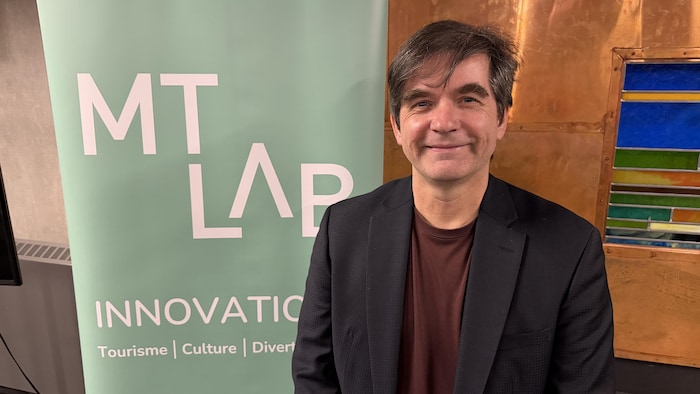
Martin Lessard, general director of MT Lab.
Photo : Radio-Canada / JEAN-MICHEL COTNOIR
I came here and I saw the partners, I saw the people collaborating together. This is element number 1. Do people want to collaborate together? I saw that here. Not that in other regions they don’t have it, here I saw it, it worked really well and that’s why we settled here
he observes.
The president of Tourisme Abitibi-Témiscamingue, Frédéric Arsenault, says he agreed to jump head-on into the adventure after taking the time necessary to understand the essence of the project.
People are all quite familiar with sustainable tourism, that is to say tourism with zero impact on the territory where the tourist comes to spend a certain period of time. When we talk about regenerative tourism, the tourist leaves a positive imprint on the territory in which he or she will stay. So, the arrival of tourists improves the ecosystem and makes it possible to regenerate certain sites which have been, for different reasons, exploited by time or damaged
he explains.
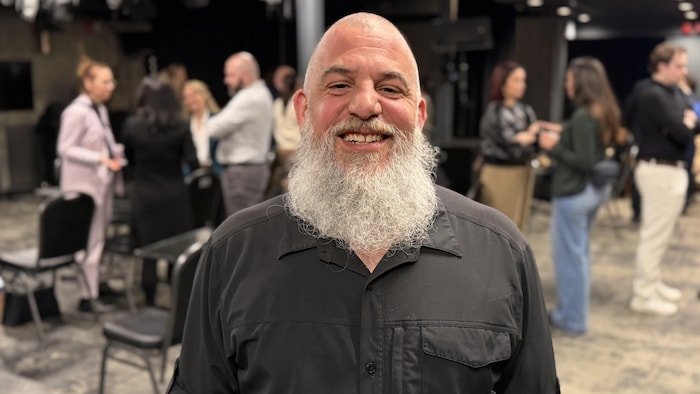
Frédéric Arsenault, president of Tourisme Abitibi-Témiscamingue.
Photo : Radio-Canada / JEAN-MICHEL COTNOIR
Floating islands on Lake Osisko
The director of communications at the City of Rouyn-Noranda, Anne-Marie Nadeau, emphasizes that the solutions that will be put in place aim to contribute to tourist vitality, but also to improve the quality of life of citizens.
Currently, we have a first cohort, called incubates, who have started, who are supported by the MT Lab. In the City of Rouyn-Noranda, we are in contact with two of the startups [entreprise émergente]one of whom wants to make floating vegetated islands on Lake Osisko. This is already a project that was presented as part of another innovation project, called AquaHacking. This company was very immature when they came to Rouyn-Noranda last year. They continued their project and there, through the MT Lab, they will see how it is possible to move from an idea to a concrete solution that can be applied.
she mentions.
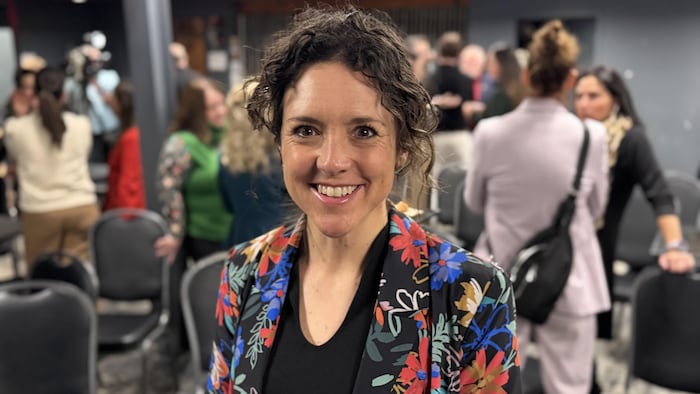
Anne-Marie Nadeau, director of communications at the City of Rouyn-Noranda.
Photo : Radio-Canada / JEAN-MICHEL COTNOIR
As for the medium-term impact of the Regenerative Innovation Cluster on the number of tourists in Abitibi-Témiscamingue, Martin Lessard was conservative.
We agree, we will never attract mass tourism, so it is individual tourism. A worker, who comes to work here temporarily, is a form of tourism. It’s business tourism. In a way, the tourist and the citizen are similar, the border is really not obvious. If we manage to show that it is an interesting region, that things are happening, that there is innovation, that those who believe in it show it and that we are proud, they will want to stay here, they will not be in in et out. We are building an attractiveness for the region, tourist-citizen
he concludes.