The LGBTQIA+ Pride March – or Paris Pride – will take place on Saturday June 28, 2025. It will celebrate equal rights and the visibility of the lesbian, gay, bi, trans, intersex, asexual and queer communities while in the United States, Russia, in Hungary or Italy, discrimination based on morals, sexual orientation or gender identity is increasing. Contrary to a discourse promoted by American conservatives, which tends to oppose Christian values and the defense of gender minorities, the history of Christianity shows that saints that we would call today “Transgender” was indeed promoted by the medieval Church.
In the United States, several Republican-led states have restricted the rights of transgender people: Iowa signed a law removing civil rights protections for transgender people; Wyoming banned public agencies from requiring the use of preferred pronouns; and Alabama recently passed a law that recognizes only two sexes. Hundreds of bills have been introduced in other state legislatures to restrict the rights of transgender people.
Earlier in the year, several presidential decrees were issued to deny transgender identity. One, titled “Eradicating Anti-Christian Bias,” claimed that the Biden administration’s gender-affirming policies were “anti-Christian.” He accused Biden’s Equal Employment Opportunity Commission of forcing “Christians to affirm a radical transgender ideology contrary to their faith.”
Yet, clearly, not all Christians are antitrans. And in my research into medieval history and literature, I found evidence of a long history in Christianity of what today might be called “transgender” saints. Although the term did not exist in medieval times, the idea of men living like women, or women living like men, was undoubtedly present during this period. Many scholars have suggested that the use of the modern term “transgender” provides valuable connections for understanding historical parallels.
There are at least 34 documented accounts of the lives of transgender saints dating back to the early centuries of Christianity. Initially written in Latin or Greek, several stories of transgender saints have been translated into vernacular languages.
Transgender Saints
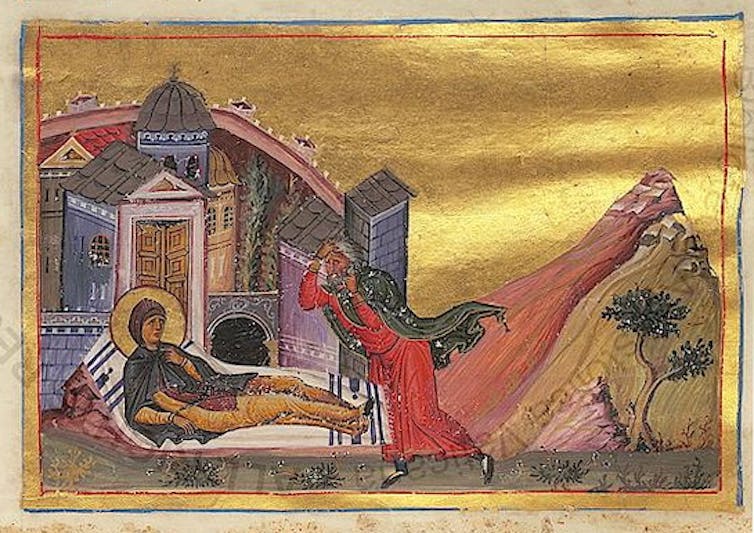
Among the original 34 saints, at least three gained great popularity in medieval Europe: Saint Eugenia, Saint Euphrosyne and Saint Marinos. All three were born women, but cut their hair and put on male clothing to live as men and enter monasteries.
Eugénie, raised in the pagan religion, entered the monastery to learn more about Christianity and became an abbess. Euphrosyne entered the monastery to escape an unwanted suitor and spent the rest of her life there. Marinos, born Marina, decided to renounce her status as a woman and live with her father in the monastery as a man.
These stories were widely read. Eugénie’s story appeared in two of the most popular manuscripts of the time: Lives of saintsof Elfric, and the Golden Legendby Jacques de Voragine. Ælfric was an English abbot who translated the lives of the Latin saints into Old English in the 10thecentury, thus making them accessible to a large lay public. The Golden Legend a été écrite en latin et compilée au XIIIe centuryÂ; it is part of more than a thousand manuscripts.
Euphrosyne also appears in Elfric’s Lives of the Saints, as well as other Latin, Middle English, and Old French texts. The story of Marinos is available in more than a dozen manuscripts in at least 10 languages. For those who could not read, Elfric’s Lives of the Saints and other manuscripts were read aloud in churches during church service on the saint’s feast day.
Anonymous via Wikimedia Commons
A small church in Paris built in thee century was dedicated to Marinos, and the relics of his body would have been preserved in the monastery of Qannoubine in Lebanon.
All this to say that many people were talking about these saints.
The sacrée transidentité
In the Middle Ages, the lives of saints were less important from a historical point of view than from a moral point of view. As a moral tale, the audience was not supposed to reproduce the life of a saint, but to learn to imitate Christian values.
The transition between man and woman becomes a metaphor for the transition between paganism and Christianity, between wealth and poverty, between worldliness and spirituality. The Catholic Church opposed cross-dressing in laws, liturgical meetings and other writings. However, Christianity honored the holiness of these transgender saints.
In a 2021 collection of essays on transgender and queer saints in medieval times, scholars Alicia Spencer-Hall and Blake Gutt argue that medieval Christianity considered trans identity sacred.
“Transidentity is not only compatible with holiness; transidentity itself is sacred,” they write. Transgender saints had to reject convention in order to live their authentic lives, just as early Christians had to reject convention in order to live as Christians.

From Monday to Friday + Sunday, receive free analyzes and analysis from our experts for another look at the news. Subscribe today!
Literature scholar Rhonda McDaniel explains thateCentury in England, the adoption of Christian values of rejecting wealth, masculine militarism, or sexuality made it easier for people to move beyond strict ideas about male and female gender. Instead of defining gender by distinct values for men and women, all individuals could be defined by the same Christian values.
Historically, and even in contemporary times, gender is associated with specific values and roles, such as assuming that household chores are reserved for women or that men are stronger. But the adoption of these Christian values allowed individuals to transcend these distinctions, particularly when they entered monasteries and convents.
According to McDaniel, even cisgender saints like Saint Agnes, Saint Sebastian and Saint George embodied these values, showing that any member of the public could fight against gender stereotypes without changing their body.
Agnes’ love for God allowed her to renounce her role as wife. When she was offered love and wealth, she rejected them in favor of Christianity. Sebastian and George were powerful Romans who, as men, were expected to engage in violent militarism. However, both rejected their violent Roman masculinity in favor of Christian pacifism.
A life worth imitating
Although most of the lives of the saints were written primarily as tales, the story of Joseph of Schönau was told as being both very real and worthy of public imitation. His story is told as a historical account of a life that would be accessible to ordinary Christians.
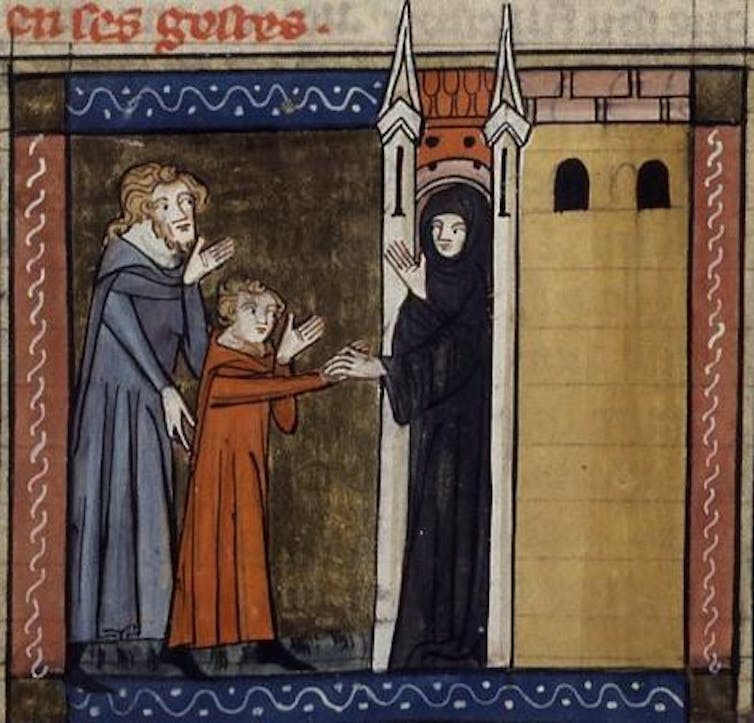
À the end of XIIe century, Joseph, born a woman, entered a Cistercian monastery in Schönau, Germany. On his deathbed, Joseph told the story of his life, including his pilgrimage to Jerusalem as a child and his difficult return to Europe after his father’s death. When he finally returned to his hometown of Cologne, he entered a monastery as a man, in gratitude to God for bringing him home safely.
Although he argued that Joseph’s life was worthy of imitation, the first author of the Joseph story, Engelhard of Langheim, had a complex relationship with Joseph’s gender. He claimed that Joseph was a woman, but regularly used masculine pronouns to refer to him.
Richard of Montbaston via Wikimedia Commons
Although the stories of Eugenie, Euphrosyne, and Marinos are told as morality tales, their authors also had complex relationships with the issue of their gender. In the case of Eugénie, in one manuscript the author refers to her using only female pronouns, but in another the scribe uses male pronouns.
Marinos and Euphrosyne were often referred to as men. The fact that the authors referred to these characters as male suggests that their transition to masculinity was not just a metaphor, but somehow as real as Joseph’s.
Based on these narratives, I argue that Christianity has a transgender history from which to draw and ample opportunity to embrace transgenderism as an essential part of its values.