In Jerusalem, Easter celebrations will be held behind closed doors or with very limited access, a rare situation in times of war. After the prevented Palm Sunday, security restrictions are reshaping access to holy places and weakening a religious balance already under tension.
In Jerusalem, Easter will take place in unusual silence. In the Basilica of the Holy Sepulchre, a central place in Christianity where tradition places the crucifixion, burial and resurrection of Christ, the celebrations will take place behind closed doors or with extremely restricted access. The faithful will be kept at a distance, invited to follow the services by retransmission.
The announcement, made by Latin Patriarch Pierbattista Pizzaballa, marks a turning point. If the basilica had already been closed to the public during the Covid-19 pandemic in 2020, the current situation fits into a completely different context. It is no longer a global health crisis which imposes the closure, but a regional armed conflict whose effects are directly felt on the city.
Since the start of the war involving Israel, the United States and Iran, Jerusalem has lived under a reinforced security regime. Access to the Old City is limited, gatherings are strictly regulated, and holy places are considered high-risk areas. The authorities cite in particular the difficulties of emergency response in the event of an attack and the concrete threat represented by the debris of intercepted missiles.
On March 16, several fragments fell in the immediate vicinity of major religious sites, including the surroundings of the Holy Sepulcher and the Esplanade des Mosques. No intentional targeting was established, but the effect was immediate. In a dense city, with narrow streets and usually large flows of faithful, the risk of a major incident is considered too high.
In this context, the holy places of the three monotheistic religions find themselves simultaneously affected. During Ramadan, access to Al-Aqsa Mosque was heavily restricted, often prohibited. The Western Wall, a major place of prayer in Judaism, is subject to similar limitations. For Christians, it is now the heart of the liturgical calendar which is directly affected.
Beyond practical constraints, it is the very atmosphere of Jerusalem that is transforming. A city of pilgrimage and gathering, it operates today under control, with filtered access and an omnipresent security presence. The crowds have disappeared, replaced by surveillance devices. The collective dimension of the rites, essential in the three traditions, is suspended.
Palms prevented from the uncertainty of the sacred fire
Even before Easter, a first signal was given during Palm Sunday on March 29. Traditionally, this celebration gives rise to a large procession between the Mount of Olives and the Old City, bringing together thousands of faithful from all over the world. This year, it was not able to take place in its usual conditions.
Above all, an unprecedented incident left its mark. Patriarch Pierbattista Pizzaballa was refused access to the Holy Sepulcher by the Israeli police, in the name of the restrictions in force. The decision, quickly lifted after government intervention, sparked a strong international reaction.
Beyond the episode itself, it is the principle of the status quo which is weakened. Inherited from the Ottoman period and adjusted over the decades, this framework organizes the coexistence of different faiths in holy places. In particular, it guarantees free access to religious leaders and supervises liturgical practices. In theory, these rules should be maintained regardless of political circumstances.
But the war introduces a new variable. Israel, as the power controlling East Jerusalem since 1967, bears responsibility for security. A mission which sometimes comes into direct tension with freedom of worship. The simultaneous closure of the holy places of the three religions illustrates this difficulty.
In this context, the question of Easter celebrations goes beyond the Christian framework. It becomes an indicator of Jerusalem’s capacity to maintain its historical balances under pressure.
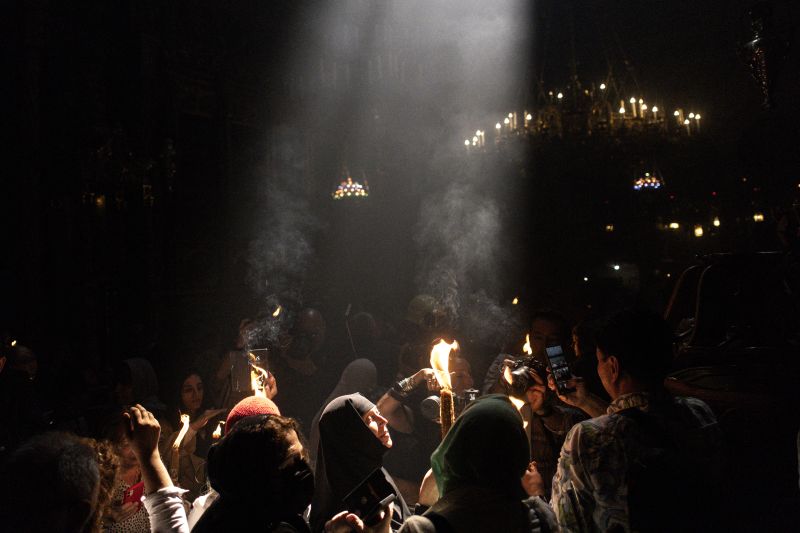
It is in this perspective that a major question arises: that of the Orthodox sacred fire. This ceremony, celebrated one week after Catholic Easter according to the Julian calendar, constitutes one of the most emblematic moments of Eastern Christianity.
Every year, in the darkness of the Holy Sepulchre, the Greek Orthodox patriarch enters the aedicula of Christ’s tomb to bring back a flame, then transmitted to the faithful. The ritual usually attracts thousands of people and is distributed worldwide.
Above all, it was never interrupted. Neither wars, nor political tensions, nor even the Covid-19 pandemic have prevented it from holding up. In 2020, the ceremony was held behind closed doors, preserving its symbolic continuity despite the absence of an audience.
Today, uncertainty remains. Current restrictions could force the ceremony to a minimal format, or even profoundly modify the conditions of access. No cancellation scenario has been officially mentioned, but the context remains unstable.
The sacred fire embodies a form of permanence, the idea that certain gestures survive crises without being interrupted. Its possible alteration would highlight a deeper issue: the capacity of holy places to preserve a form of continuity in an environment marked by rupture.
In Jerusalem, where religion and politics are closely linked, this tension is constant, but rarely so visible. By depriving the faithful of access, war not only disrupts practices: it reconfigures, at least temporarily, the link between faith, space and power.
A few days before Easter, in a city where rites have always survived crises, will the flame of the sacred fire be able, once again, to be transmitted, or is war imposing a break even in this immutable cycle?
Â