Organizations like World Vision, Plan International or Care did not invent child sponsorship: this practice is part of a long history. In Quebec, generations grew up “buying little Chinese” through the Å’uvre de la Sainte-Enfance, a practice today fraught with memories… and questions.
Until 1965, primary school children were asked to contribute (5, 10 or 25 cents) to this organization. The expression “buy little Chinese” evokes memories or misunderstandings depending on the age of the person who encounters it.
Contributing children received a card with the image or photo of “their” Chinese (or African) child. The money, they were told, was used for the conversion, education and care of these children.
Several people have since questioned this practice, for its commercial dimensions, its overtones of racial superiority or the perceived, even real, exploitation of donor children.
The Work of the Holy Childhood, a Catholic missionary financing organization founded in the 19thecentury in France, has also been the subject of questions regarding the reality of the aid provided and the final destination of the money. Michel Tremblay thus makes his mother speak in Assorted candies (2002): “Well what?” Are you following her, is that money? Huh? Do you know where this is really going? Are you taking the boat to China or the edge of the nuns’ drawers?
We are three members of a research team that has been working for several years on the Work of the Holy Childhood and its memory in Quebec. In this context, we consulted various archives and conducted a series of oral history interviews. The witnesses from the baby boom generation that we met, among other things, reinterpreted their Catholic involvement with a Manichean vision of the world in the way that the religious context of their childhood instilled in them, but where the traditional references seem to have been clouded by doubt.
Our research, the objective of which is to open a space for dialogue and reflection on the themes of racism, religion and solidarity, also allows us to answer the question that all former child contributors ask us about the destination of their donations.
If we first see history as a discipline that produces facts, we maintain that it also has a therapeutic and emotional function, putting an end to doubts carried over from childhood. These doubts may be linked in particular to feelings of deception or institutional manipulation.
Read more: This is how French Canadian workers spoke before the Quiet Revolution
Revealing memories of secularization
“But where did the money go?†Several people we met questioned the final destination of the money they gave as children. Doubt about the reality of the help provided, or even the certainty of having been the victim of a scam, makes this question a sort of memorial commonplace.
It is part of the landscape of a faith which is metamorphosing through the secularization of Quebec society, where growing embarrassment and distrust towards the Catholic Church has been cultivated. Our witnesses go so far as to argue that it is certain that the priests and sisters embezzled the funds.
An encompassing and Manichean reading of the Church as a large entity offers a clue to understanding the formation of sharp impressions towards ecclesiastical financial practices, testimony to a vague feeling of betrayal shared by people for whom religion governed the understanding of the world during childhood.
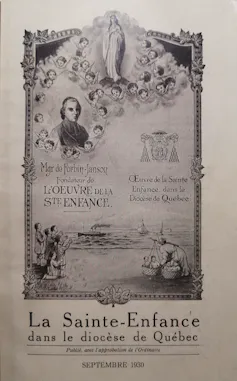
(BANQ)
The memory of involvement in the Work is also colored by the sexual abuse scandals linked to the Catholic Church as well as those concerning the finances of humanitarian organizations. While the relationship that these people developed with faith and the Church as children was above all familial and localized, their current conception is more global. In this context, the Church is not thought of in its complexities and its different scales.
If the oral history interviews shed light on this memory doubt and the affects it arouses, the archives of the work – another source at the center of our approach – come to offer answers and reassurance to the witnesses.
Read more: Referendum and national narrative: the blind spots of black history in Quebec
The answers of historical research to memory doubt arising from childhood
We traveled throughout Quebec and elsewhere to search the archives of various dioceses (Montreal, Ottawa, Saint-Jérôme, La Pocatière, Amos, Trois-Rivères). In each of them, annual reports were produced from correspondence received from the schools, detailing the amount given in each establishment – both large convents and state schools.
The precision sometimes went as far as listing the amounts by class. Annual reports are also produced by the national direction of the French Canada sector, presenting the revenues and expenditures of each diocese. All these documents were circulating in the province.
We also went to Rome where the general archives of the work are located. On site, we find details of the deliberations of the central council regarding the allocation to be sent to the different missions. Requests made annually by missionaries are also kept.
In the Annales de la Sainte-Enfance, published annually in Paris by the central direction of the work, we find not only an assessment of the financial achievements of each region of the world, but also the details of the distribution of funds throughout the world (in Asia, Africa, South America, North America, etc.). It is therefore the central institution which manages the distribution of resources, but these are indeed assigned to missions, as promised by missionary propaganda.
In these different deposits, we have therefore gone through numerous account books, correspondence, annual reports, detailed lists of the amounts allocated… even the reproaches of the national director of the work in French Canada to the bishops who did not favor the organization enough in their diocese or to the nuns who kept the money from the Holy Childhood for their own missions. Thus, the financial and administrative archives of the work make it possible to trace the path of the donations and to reassure our witnesses.
Does this exclude small-scale embezzlement? No way. But this nevertheless proves that as a whole, Sainte-Enfance fulfills its commitments to its young associates.
When at the end of the interview, we asked the witnesses what they would like to know about the history of the Holy Childhood, the question of the fate of their “10 cents” often came up. Faced with these doubts which seemed to be expressed by the children of yesteryear, we were able to respond. The emotional relief that followed was palpable.
While sexual abuse scandals and certain questionable financial practices are undoubtedly part of the history of the Catholic Church, our research shows that there is sometimes a disconnect between the public image of an institution at a given moment and the reality – much more complex – of its historical journey.