It was in 2016 that the first spin-off of the series Monster Hunter appeared on 3DS. It is no longer a question of a real-time game in which you have to read the patterns of iconic monsters in order to find the right timing to beat them, but of turn-based combat in the JRPG style with a component Pokémon asking us to catch beasts to make them fight. If the idea was interesting and well executed, the 3DS support did not allow the game to stand out technically, probably explaining why many missed it despite the quality of the title. Fortunately this third episode frees itself from technically limited supports and allows Capcom to offer an extremely attractive game with its well-mastered cel shading and superb gameplay providing pleasure and dopamine once the pad is in hand.
Environmentalists
In the spin-offs Storiesit is not a question of playing a hunter having to beat a monster to make socks, and optionally reestablish the ecological balance of the area. Here, we play a Rider whose goal is to steal the eggs of our good old dragons and other Godzillas in order to raise them to release them later into the wild and prevent their species from becoming extinct. Counterintuitive, let’s admit it, but it’s a bit of the series’ habit, spin-off or not, to sell us cryptozoological castagne ethically.
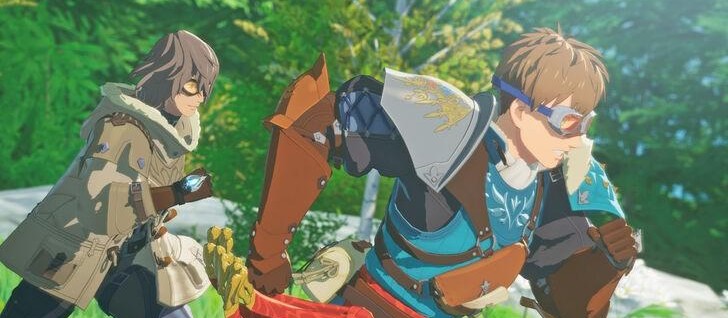
An evil is consuming the territory of Azuria and some monsters are going crazy after being infected by a disease that causes crystals to grow on certain parts of their bodies. At the same time, the neighboring nation threatens to invade you because its territory has become unsuitable for agriculture and risks sinking into famine. It is in this geopolitical context that your character, the princess of the kingdom, and her whole band of Monsties (tamed monsters) and Riders, will resolve this problem with swords in the local Rathian to save her species. It’s for their own good that we tell you!
Rock, paper, scissors… well, fountain, counter-kem’s, UNO!
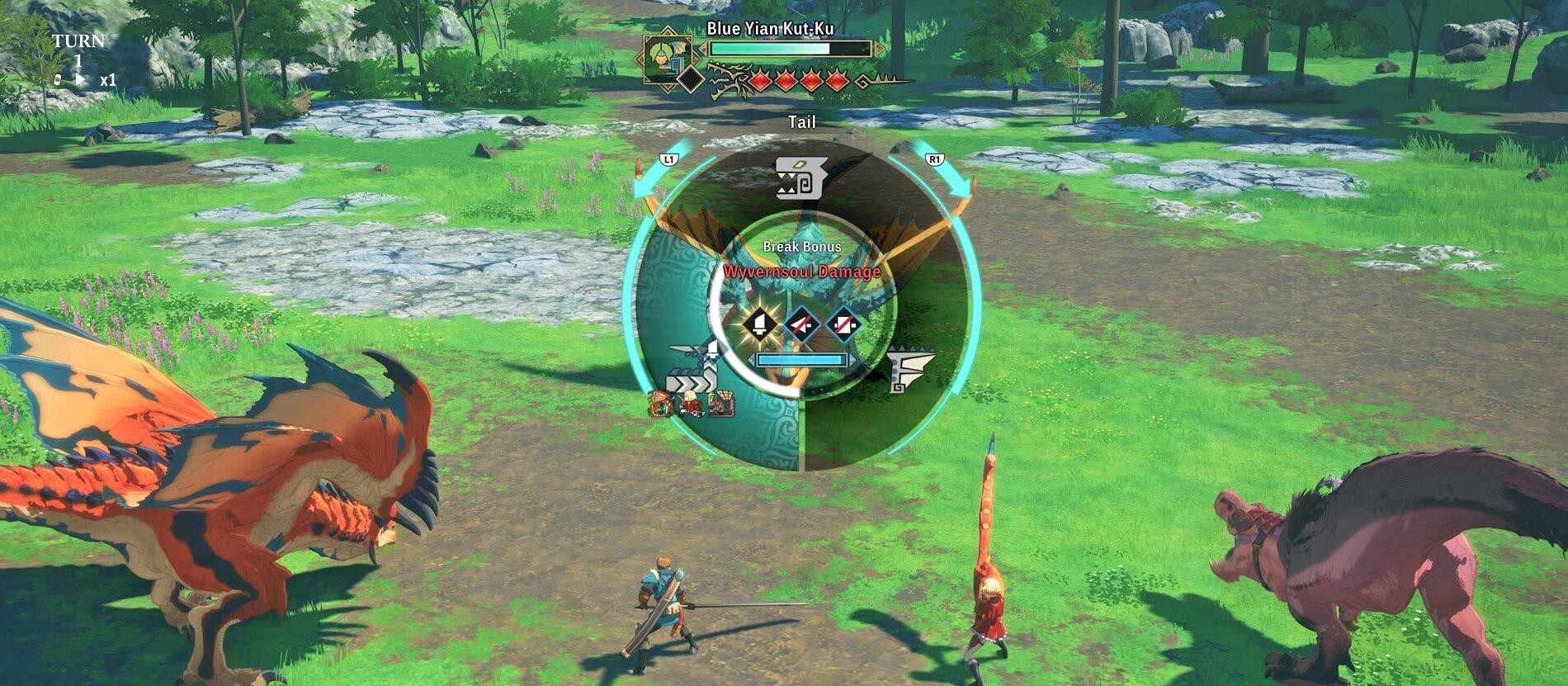
If the first episodes use the principle of paper, rock, scissors to infuse a little strategy into the turn-based combat, this third opus complicates the system, perhaps to the extreme. Even after dozens of hours of play, there are still things that are a little vague and difficult to understand. We start with the classic Strong, Technical or Fast attacks, which act as Shifumi. Strength beats technique which beats speed which beats strength. You will therefore have to be careful to identify which member of your team the monster is targeting (you can see at each turn who is targeting what) and bet on choosing the right attack. In the case of a victory, that of the monster is canceled and only yours will hit the mark. In case of a tie, both succeed.
Added to this system are talents that operate by consuming energy. These are skills that do more damage, target more enemies or allow you to buffer your team or debuff enemies. The techniques depend on one of the three types of weapons you can carry. There are six weapon archetypes, out of the fourteen that the Monster Hunter classic knows. The great sword and the katana of the cutting type, the hammer and the horn fighter of the blunt type, the bow and the lance cannon of the piercing type. This is important, because monsters are divided into parts that can be broken to recover the components necessary for crafting, and each part is weak to a particular type.
That’s not all! There is also the friendship gauge with your Monstie, which you can change at will among a team of 6, which fills up during the fight and which allows you to switch to mount mode by riding it to make a devastating attack once full. Ah! I forgot! I haven’t talked about the posture gauge of enemy monsters which must be emptied to bring down a monster in order to make a group attack at the same time. Persona. Yes, as you can see, it’s clunky but it all really captures the combat sensations of the base game, which is an achievement for turn-based.
Rathalos socks
All these fights will allow you to collect components in order to create armor and weapons, such as a Monster Hunter canonical. Each monster allows you to unlock new equipment with their elemental strengths and weaknesses, as well as the talents attached to them. The fights quickly become demanding and having the armor with the right defenses will be essential. You will have to constantly juggle, like in the original game, to be on top according to the target. Capcom also understood that players love fashion and thus allows you to equip any armor already crafted while retaining the look of your favorite one.
Crafting also involves collecting resources while traveling. It’s up to you to pick mushrooms, mine rocks, collect bones and so on. It will also be possible to visit monster dens in order to steal their eggs, as we mentioned previously. Each attempt increases the chance of waking up or bringing back the parent, generally leading to a more difficult fight than average. But this is the only way to obtain new members for your team and restore the ecological balance of the region.
You will inevitably have duplicates of species over the many hatchings carried out. Releasing duplicates into the wild increases the quality of this category. It is not enough to increase the level of your Monsties by gaining experience to be strong, you will need to capture better quality eggs in order to maximize their initial statistics. Staying on a D rank of ecosystem will lead to your loss in the long term while an S rank will allow you to raise a Promising montie!