After seeing the solution made in NVIDIA called Neural Texture Compression, here came Intel’s solution which also continues to explore the potential of artificial intelligence applied to graphics rendering with a promising new technology: Texture Set Neural Compression (TSNC). Through a recent demonstration, the firm shows that it is possible to drastically reduce the size of textures in games, while maintaining visual quality very close to current standards.
Massive compression based on neural networks
The principle of TSNC is based on the use of neural models to replace traditional compression methods such as the BCn format. Concretely, existing textures are first processed by an AI-based encoder, which converts them into a much more compact representation. They are then reconstructed in real time via a neural decoder directly on the GPU.
The result is impressive: Intel announces textures up to 18 times lighter, with an almost imperceptible loss of visual quality in the majority of cases. This approach not only reduces the size of games, but also relieves pressure on VRAM and improves overall performance.
Two approaches according to needs
Intel offers two variants of its technology, each meeting different objectives. The first, called Variant A, aims for a balance between compression and visual fidelity. It allows you to reduce the size of textures up to 9 times while maintaining a quality very close to the original, with a degradation estimated at around 5%, difficult to perceive with the naked eye.
Variant B pushes the slider much further, with compression of up to 18 times. Here, the gain in efficiency is maximum, but is accompanied by a slight drop in quality, estimated at up to 7%. A compromise which remains acceptable in many cases, in particular to optimize performance or drastically reduce the size of installations.
Concrete gains for games and hardware
The interest of the TSNC is not limited to the simple reduction in size. By reducing the weight of textures, this technology allows faster loading times, reduced memory consumption and better exploitation of GPU resources. In a context where VRAM becomes a limiting factor, particularly on certain configurations, this type of innovation could change the situation.
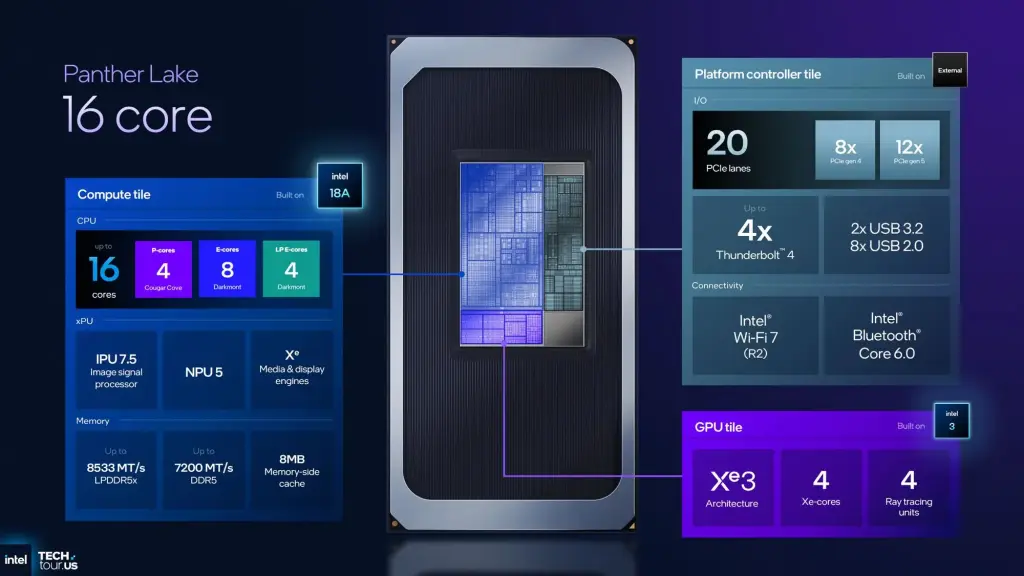
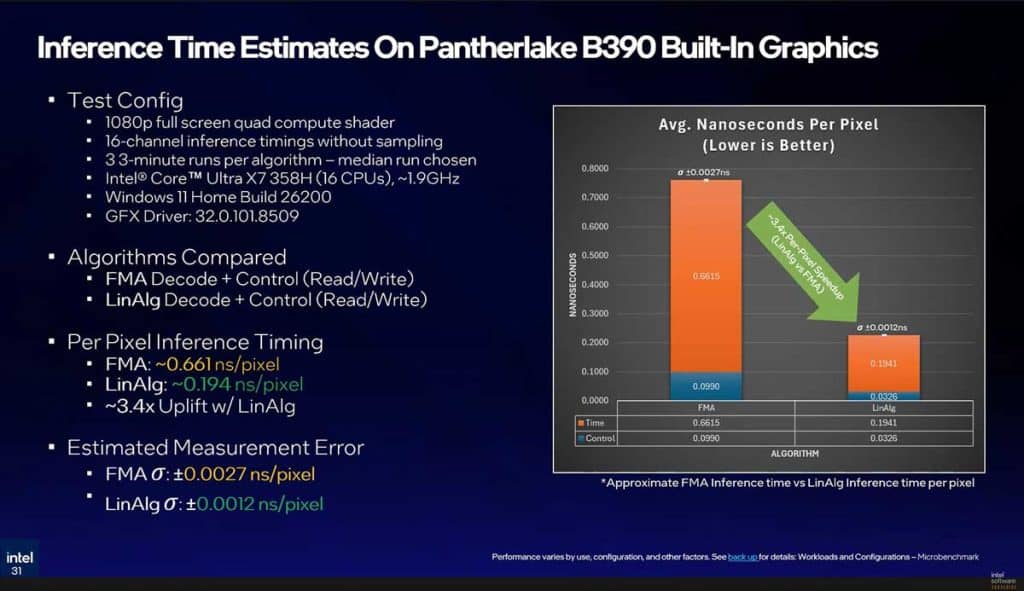
Intel also highlighted the performance of its system on a recent platform based on the Panther Lake architecture and integrated Arc B390 graphics. Thanks to the XMX cores dedicated to AI, texture decoding is carried out with an extremely low latency, of the order of 0.194 nanoseconds to generate the first pixel. A sufficient level of responsiveness to guarantee a smooth experience without any perceptible impact in-game.
Towards gradual adoption in the industry
Like any emerging technology, TSNC is still in its infancy. Intel is talking about an initial launch in alpha form later this year, before beta and then stable versions in the longer term. No precise timetable has yet been communicated, but the direction is clear: gradually integrate these neural methods into the heart of the rendering pipeline.
With this approach, Intel is part of a broader industry trend, where artificial intelligence is no longer limited to upscaling or ray tracing, but is beginning to fundamentally transform the way graphics assets are stored, processed and displayed. If the promises are kept, this could well redefine the technical standards of future games.