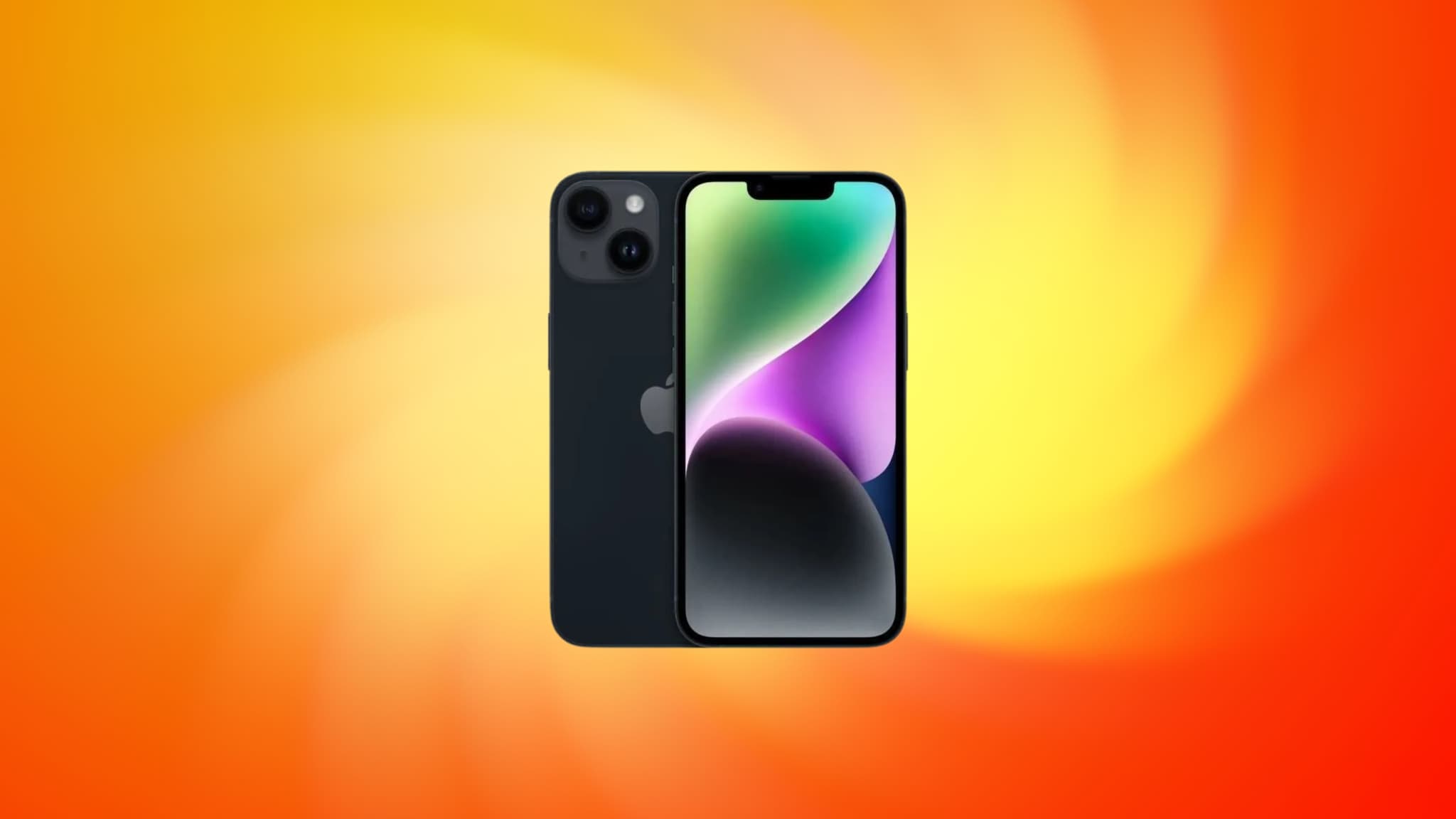
Amazon would consider buying Globalstar, a low-orbit (1,414 km) satellite operator, according to the Financial Times. Having become a strategic link in the iPhone thanks to emergency SOS, the group is 20% owned by Apple. In the background: Amazon’s attempt to catch up with Starlink in the constellation race.
The satellite market could soon change – and Apple finds itself at the heart of the maneuver. Amazon would consider buying Globalstar, a still discreet low-orbit telecoms operator, according to an article in the Financial Times published on April 2, 2026. Behind this operation there is much more at play than a simple takeover: the control of an infrastructure that has become critical for millions of iPhones.
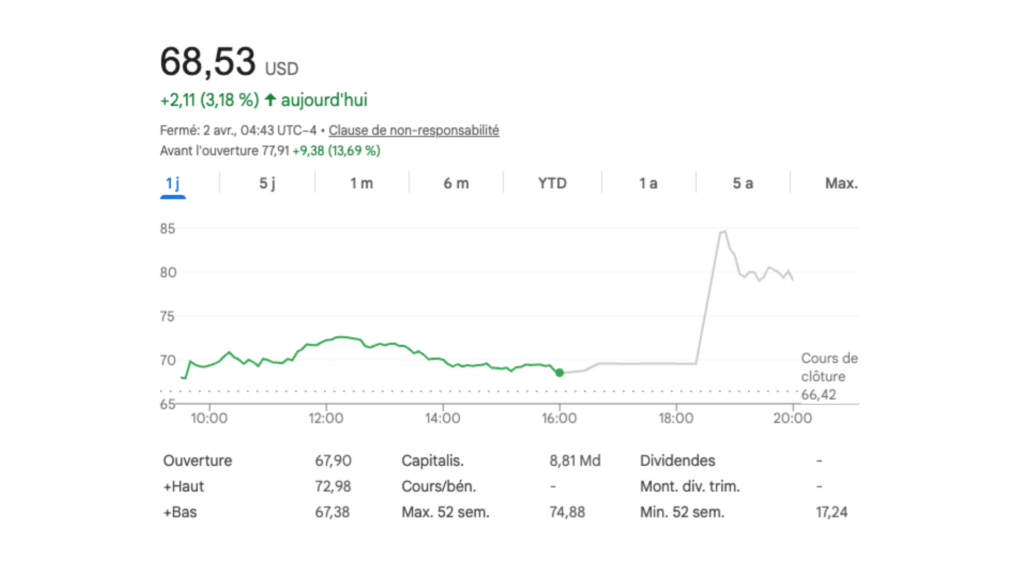
Relatively unknown to the general public, Globalstar is nevertheless approximately 20% owned by Apple, which has invested nearly 1.5 billion dollars to secure essential satellite capacities, particularly for emergency SOS. The company is valued at around $9 billion on the stock market and its stock jumped from around 15% to more than 20% in extended trading on 1is April, after the first rumors. Over the past year, its stock has jumped around 230%.
Although still at the discussion stage, this acquisition would allow Amazon to strengthen its constellation, called Amazon Leo, in a context where SpaceX maintains a massive lead with Starlink.
A small operator turned strategic: who is Globalstar?
Globalstar operates satellites in low orbit, historically dedicated to niche uses such as telemetry, beacons or communications in white zones (but at an altitude of 1,414 km, when Starlink is at 550 km). For a long time, the company remained on the fringes of the sector, with a limited fleet and a fragile economic model. But everything changed when Apple decided to rely on its network.
Since the iPhone 14, the brand’s smartphones can send emergency messages without a cellular network, by connecting directly to Globalstar satellites. To make this service possible, Apple has reserved most of the network capacity, around 80 to 85%, and is largely financing the new generation of satellites as well as the ground infrastructure. Globalstar has thus moved from the status of a discreet player to that of a critical supplier of a showcase function for the iPhone.
For Apple, it is an invisible but essential infrastructure brick. The promise is simple: even isolated in the mountains or at sea, an iPhone can contact emergency services. Behind the scenes, this is based on a structuring agreement: Apple finances, prioritizes its use of the network and indirectly shapes the evolution of the constellation.
Apple is therefore not only a customer. With around 20% of the capital, the company also has strategic leverage, including a possible buyout. If Amazon took control of Globalstar, Apple would then depend on a competitor for a function directly linked to the security of its users. Apple could then give up on Globalstar and its satellite constellation.
Amazon Leo wants to catch up with Starlink, which is far ahead
Faced with SpaceX, Amazon Leo, formerly Project Kuiper, is significantly behind. The constellation now has just over 200 satellites in orbit, while Starlink has already launched more than 10,000 and claims a global customer base. However, the objective remains similar: to offer high-speed Internet access from space, for the general public and businesses, in areas poorly covered by terrestrial networks. Amazon has already signed contracts with JetBlue and Delta to provide Wi-Fi on board planes from 2027 and 2028, proof that the project is targeting concrete commercial opportunities, beyond simple technological catch-up.
In this context, Globalstar represents a strategic shortcut: rather than building each brick, Amazon could acquire an already operational fleet, ground stations, assigned frequencies and proven know-how. With, as a bonus, a premium client: Apple.
However, at the heart of the matter, three logics collide. On the side of Globalstar, a takeover by Amazon would mean a change of scale, with more resources, technical synergies and integration into a much more ambitious constellation. But also a repositioning, from an almost exclusive partner of Apple to a component of an ecosystem Amazon… with a network that is technically less good than that created by Amazon.
For Amazon, the operation ticks almost all the boxes: industrial acceleration, strengthening of Amazon Leo, acquisition of a regulated asset and generation of revenue via Apple. For the Apple firm, on the other hand, the scenario is much more ambiguous. A Globalstar supported by Amazon could secure the service over time… but could lose Apple in the process.
In the short term, Apple will have to ensure that its contracts guarantee the continuity and priority of the service, or even consider alternatives or a multi-operator strategy if dependence becomes too risky. Because by buying Globalstar, Amazon would not only get its hands on a satellite operator, but on an infrastructure linked to public security.
Difficult, in this context, to alter or degrade the SOS service without exposing yourself to major tensions, both with Apple, which has made it a key argument for the iPhone, and with regulators, for whom emergency communications constitute a priority service. A central question remains: can Apple sustainably agree to depend on a competitor for a vital function of its devices?
The rumors will have to be confirmed. HAS” In accordance with company policy, Globalstar does not comment on industry speculation or rumors †Globalstar told the Financial Times. Amazon declined to comment, while Apple did not immediately respond.

All the tech news at a glance
Add Numerama to your home screen and stay connected to the future!