Are you tired of feeling queasy every time you read on your smartphone in the car? Samsung may have the solution. With Samsung Hearapy, the South Korean manufacturer turns your earphones into a real shield against motion sickness. We explain how it works.
One in three people suffer from motion sickness. This unpleasant sensation, caused by a conflict between what your eyes see and what your inner ear perceives, disrupts the daily life of millions of people.
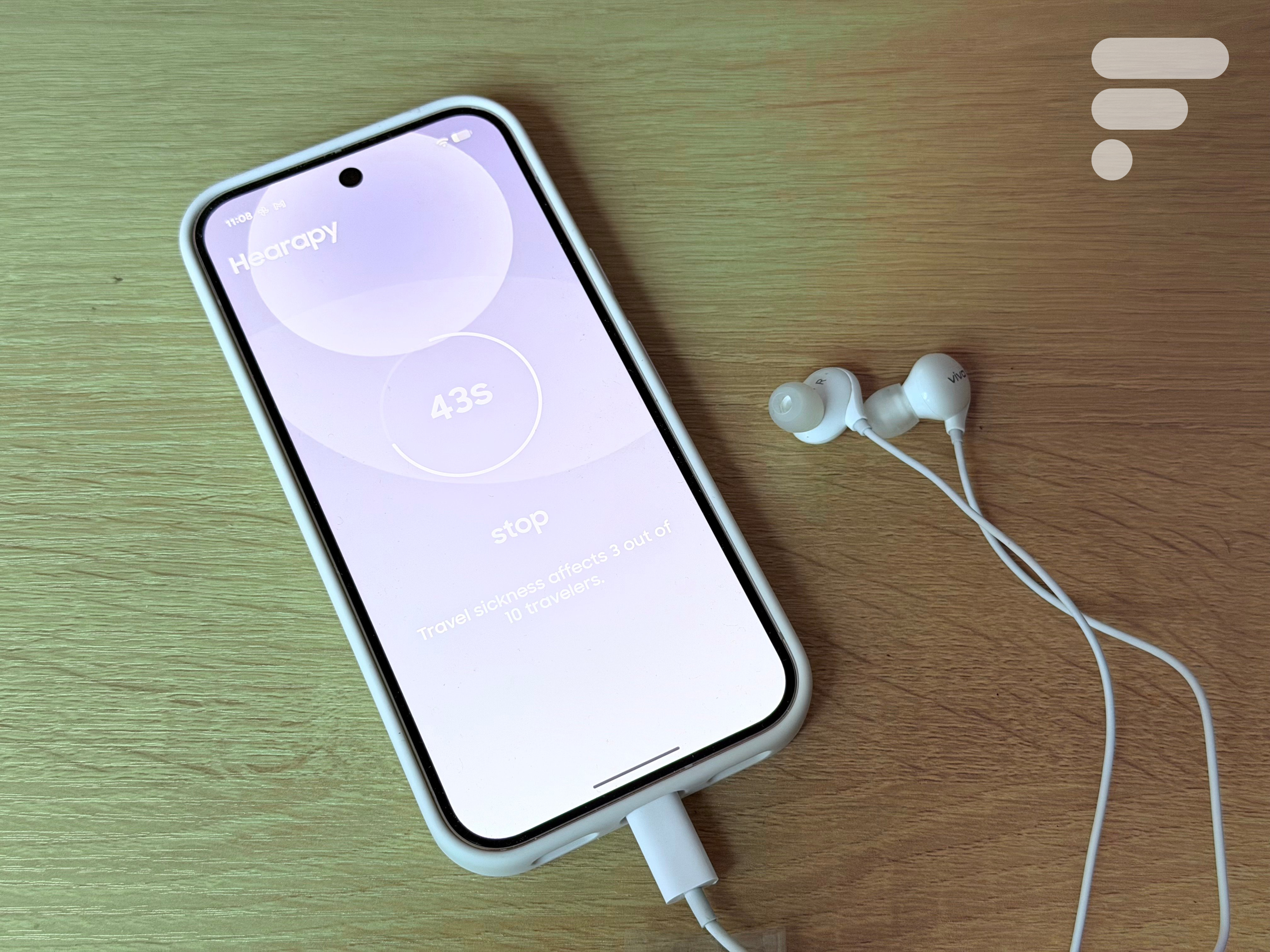
Samsung took advantage of the “World Hearing Day 2026” to unveil Hearapy, an application that aims to help you avoid taking medication to fight motion sickness.
Samsung Hearapy: how does it work?
The application is based on research from the University of Nagoya in Japan. The idea is to broadcast a pure sine wave sound of 100 Hz at a volume between 80 to 85 dB. According to the cited studies, exposure to this signal for just 60 seconds could stimulate the vestibular system and reduce symptoms of nausea, dizziness, and cold sweats.
Participants in the tests at the University of Nagoya experienced a significant reduction in stress and symptoms during a car journey.
The effect of this “sonic treatment” could last up to two hours.
Samsung specifies that “the frequency must be precisely 100 Hz and both ears must be exposed to the sound for at least one minute before starting.”
The Galaxy Buds 4 Pro highlighted
While the application is available for free on the Google Play Store, Samsung heavily promotes its new Galaxy Buds 4 Pro, which, according to them, are best at faithfully reproducing the famous 100 Hz “clean and powerful.”
To make the sound as authentic as possible, the Galaxy Buds 4 Pro feature some key points like wide speakers, compatibility with the SSC-UHQ codec (Samsung Seamless Codec Ultra High Quality) for 24-bit lossless audio transmission, and ANC.
However, that’s Samsung’s marketing spiel since Hearapy is available on any Android smartphone and works with any wired or Bluetooth earphones or headphones.
Nevertheless, “Samsung has not detailed the effectiveness of its solution on non-calibrated devices for this specific signal. To ensure perfect reproduction, a high-performance model will likely be more suitable.”
A solution broader than circles on the screen
Samsung is entering the fight against motion sickness through audio, and it’s not a bad idea. Their system is more general than the options from Apple, Oppo, and Honor. The latter display circles on the smartphone or tablet screen, following the movements of the transportation via the gyroscope. Functional, but limited to the screen of the device in question.
In theory, Hearapy should allow gaming on the Switch in the car or reading a book. It’s more versatile.