- Binance Research found that perpetual contracts RWA rose from 0.2% to 4.9% in 90 days, challenging the futures markets.
- In April, gold represented 3.6% of the COMEX and silver 13.6%, a sign of increasing discovery in cryptocurrency prices.
- Circle Perpetual Contracts (CRCL) reached 12.1% of NYSE volume, pointing to broader asset expansion.
Crypto Derivatives Jump as Perpetual RWAs Gain Market Share
Native perpetual markets for cryptocurrencies tied to real-world assets are growing at a pace that is beginning to rival traditional finance benchmarks.
According to Binance Research, data from the last 90 days shows a sharp increase in activity. The ratio of trading volume of Binance’s RWA perpetual contracts to that of major traditional futures exchanges increased from just 0.2% to 4.9%. Although this figure remains low in absolute terms, the speed of growth attracts attention.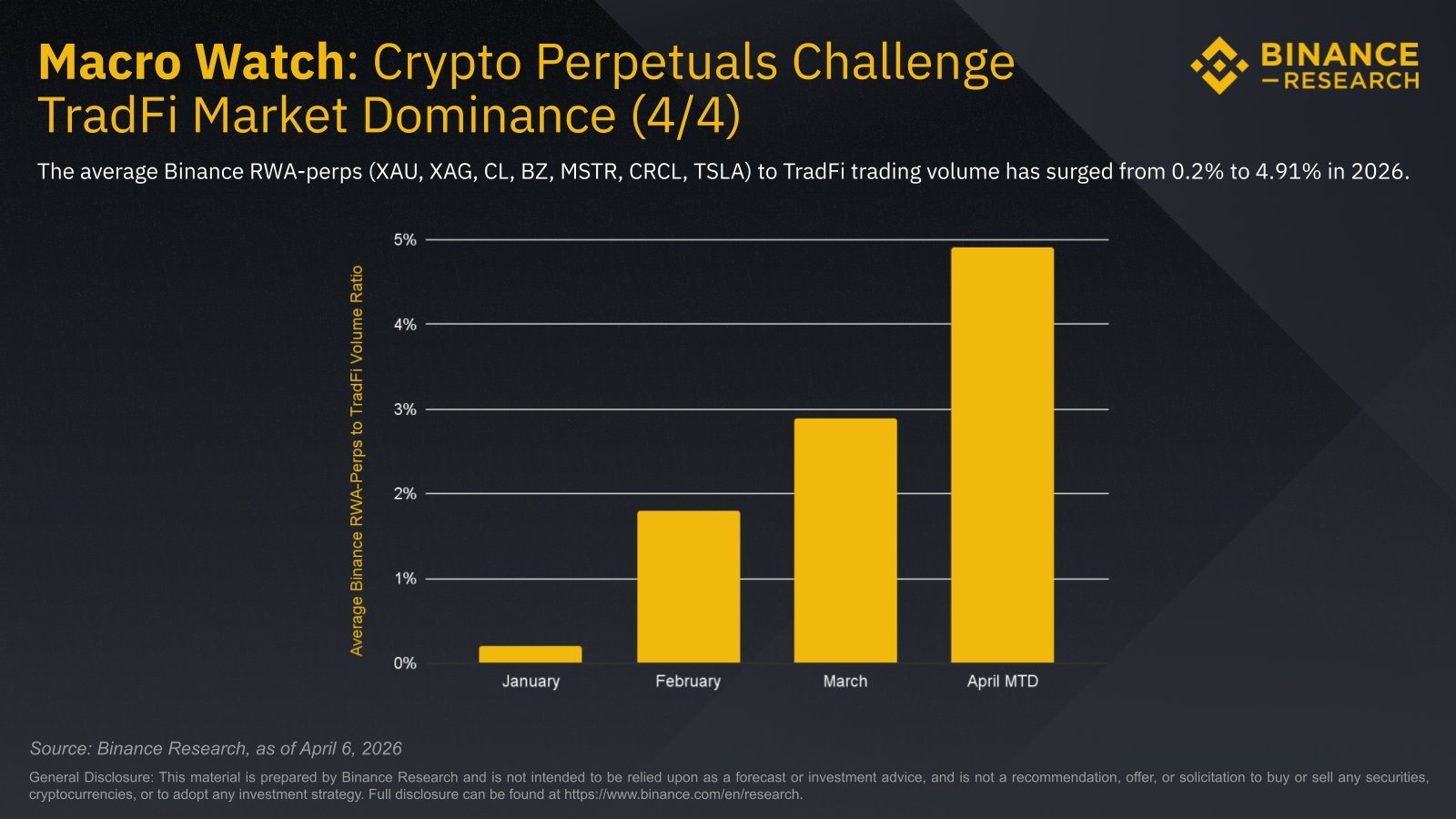
Metals are at the origin of this evolution. Gold-linked perpetual contracts increased from 0.4% of COMEX futures volume in January to an average of 3.6% in April, with peaks as high as 8.3%. Silver grew even faster. Its share jumped from 1.0% to 13.6% on average, with peaks above 20%.
Stocks show early but notable progress. Trading related to Circle (CRCL) reached 12.1% of its daily volume on the NYSE, supported by strong overlap with native cryptocurrency users. Strategy (MSTR) follows with 2.7%, while Tesla (TSLA) is still in its early stages with 0.5%.
The latest area for expansion is energy markets. WTI crude contracts reached 2.3% of traditional futures volume, compared to 1.0% for Brent. These levels reflect the situation of gold at the start of the year, before its rapid growth.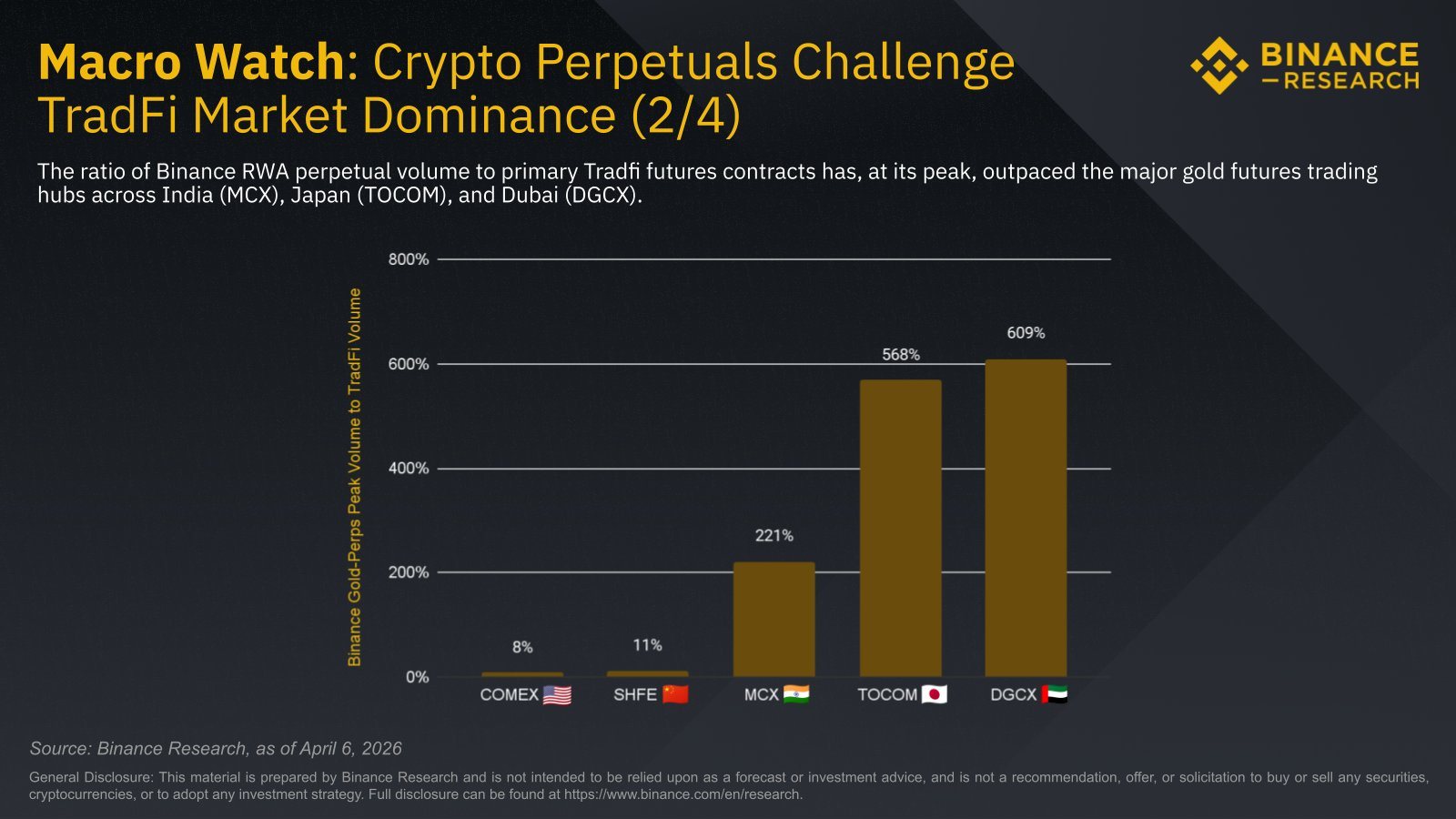
Several structural advantages favor this adoption. Cryptocurrency platforms operate 24 hours a day, allowing trading to continue when traditional exchanges are closed. Traders can also use cross-collateralization, which allows exposure to multiple assets from a single margin pool. In addition, some platforms now combine traditional and on-chain assets within the same interface. This avoids having to choose between centralized efficiency and decentralized flexibility.
This results in a faster feedback loop for price discovery. Activity, formerly concentrated on traditional markets, is starting to spread across cryptocurrency platforms. For now, traditional stock markets still dominate. But the trend is clear. If growth continues at this rate, cryptocurrency-based derivatives could begin to play a larger role in setting prices in global markets.