Tokenization applied to real-world assets (RWA) is preparing to shake up the boundaries of traditional finance in proportions that are still difficult to estimate. An observation that is all the more concrete as even the International Monetary Fund affirms it, without forgetting to mention some risks for financial stability.
Tokenization “increasingly influences the evolution of the financial system”
Initially reserved for crypto sectors such as decentralized finance (DeFi), tokenization is now emerging as the next paradigm capable of revolutionizing traditional finance, with assets registered on the blockchain more operational and accessible.
A sector that is still intimate, if we consider its capitalization currently estimated at a little less than 28 billion dollars on the site RWA.xyz, while some envisage a potential development in the thousands of billions of dollars by the end of the decade.
🔠What is tokenization and which sectors is it transforming?
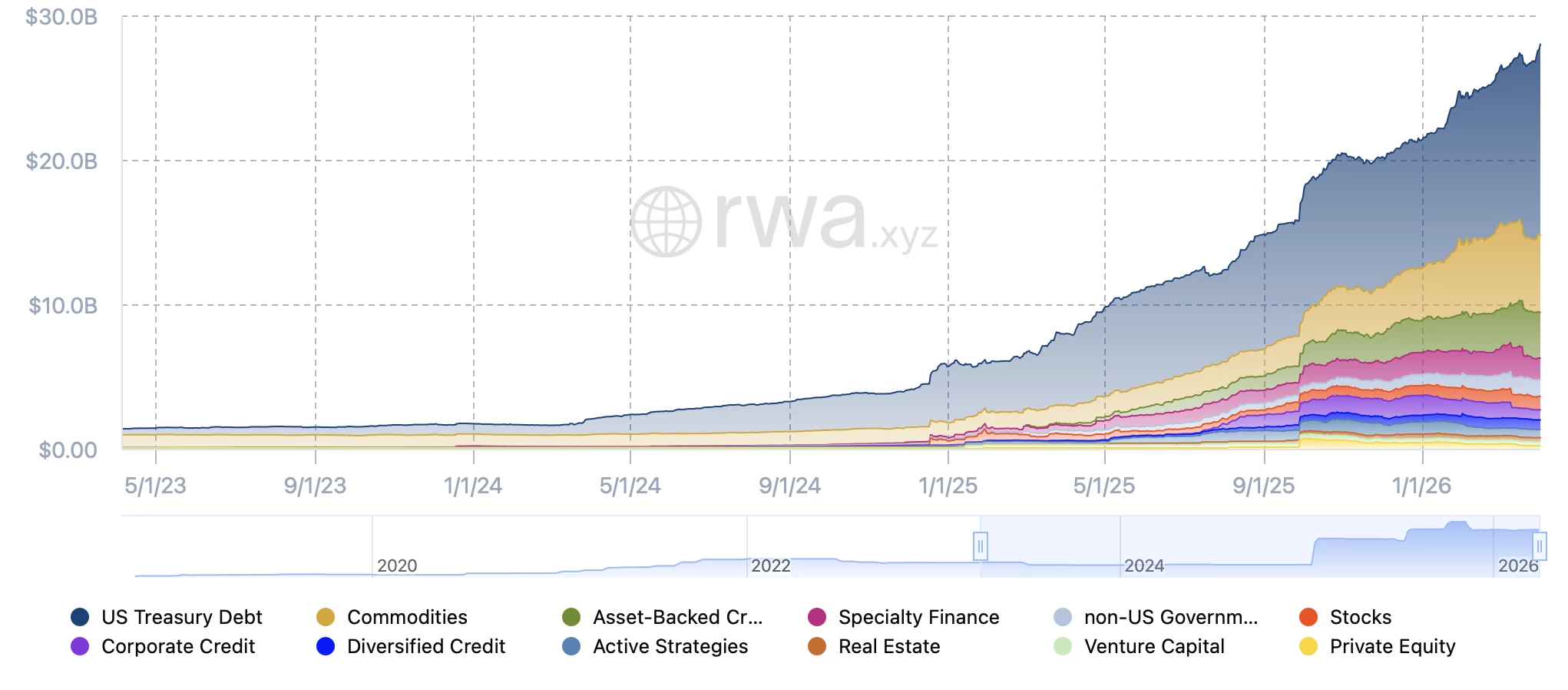
The tokenization sector is currently worth $27.65 billion
Â
Perspectives which push global economic players to take a position, such as for example the International Monetary Fund (IMF) which has just published a “Note” on its official website. A document intended for “ quickly disseminate concise IMF analyzes on crucial economic issues to member countries and all policy makerss».
Tokenization – that is to say the representation of financial assets and liabilities on programmable digital registers – is increasingly influencing the evolution of the financial system. The most significant transformation is occurring within the regulated financial system, including banks, asset managers and market infrastructures, where tokenization can enable atomic settlement, ongoing liquidity management and built-in compliance.

Create an account on Kraken and try to win 1 Bitcoin
“A structural change in the financial architecture” which is not without risks
In this document, the IMF explains that tokenization “ constitutes a structural change in the financial architecture rather than a marginal improvement in efficiency ».
And for good reason, its application to traditional finance – using ” authorized shared ledgers, programmable financial assets and smart contract-based risk management » – results in a modification of « the nature of settlement, liquidity and systemic risk ».
ðŸ—žï¸ Can Europe impose its leadership on the tokenization market?
As a result, the IMF indicates that the long-term success of this transformation relies largely on ” anchoring digital finance in the trust of its users “, with the establishment and respect of clear regulatory frameworks accompanied by safe and robust management coordinated at the international level.
In the absence of such anchors, tokenization risks amplifying financial instability through speed, concentration and fragmentation.
Receive 20 USDC + 20 € in BTC for a deposit of 100 € on Bybit EU
Source : FMI
La Newsletter crypto n°1 ðŸž
Receive a summary of crypto news every day by email 💌
Some content or links in this article may be advertising or affiliation. Investing in digital assets presents a risk of total or partial capital loss. Past performance is no guarantee of future performance. Only invest what you are willing to lose.

Passionate about cryptocurrencies and the principle of decentralization for many years, I want to share this experience with as many people as possible. I also endeavor to decipher the issues associated with the evolution of this ecosystem within traditional finance.
Hugh Bernard
760 articles