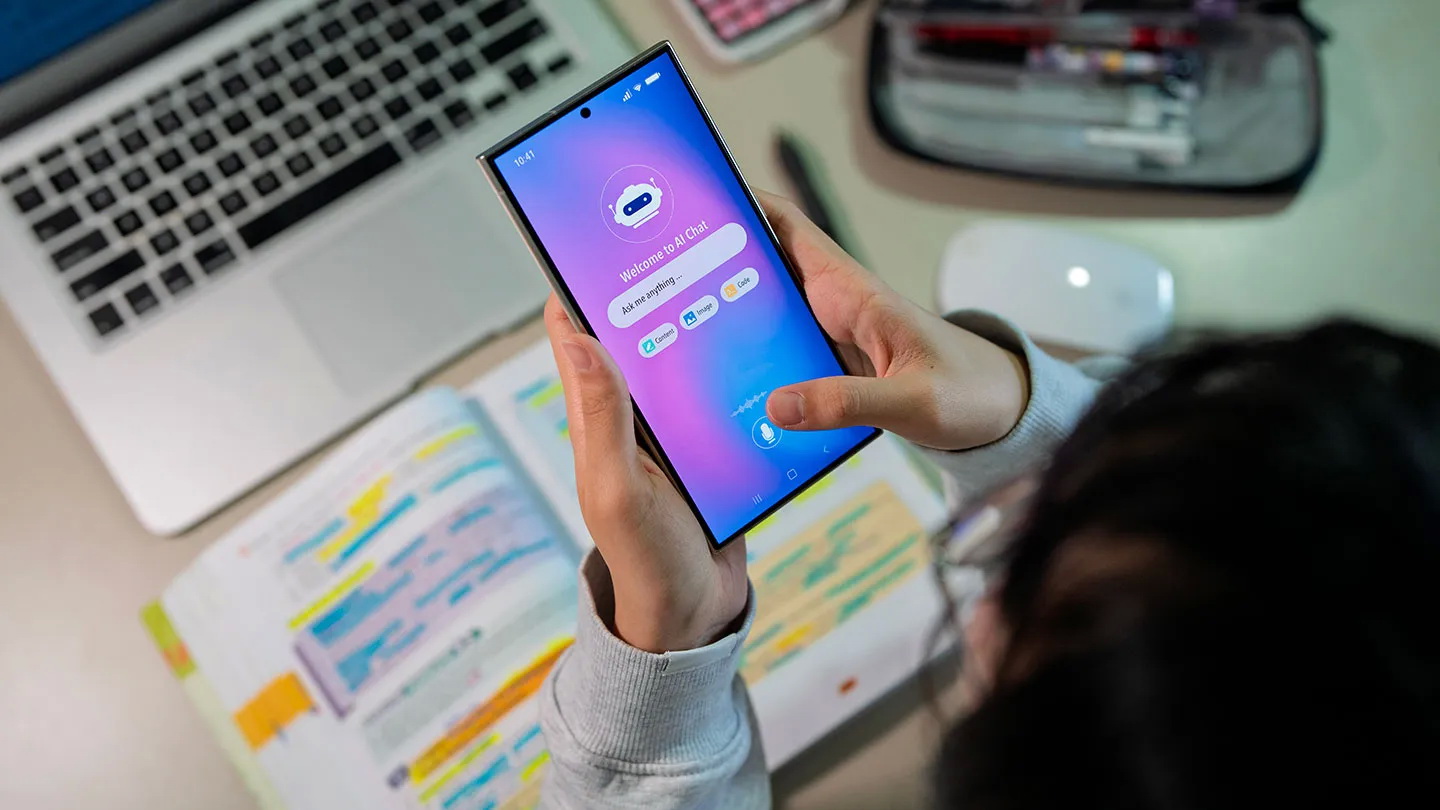
New study finds alarming number of students becoming dependent on AI – Photo: THAI LIANG LIM
20% dependence on AI
According to a recent survey by the Pew Research Center – a renowned independent research organization in the United States, specializing in opinion polls and social trends – more than half of American students aged 13 to 17 year olds reported using AI chatbots to answer questions and facilitate their learning.
The survey, conducted by the Pew Research Center among 1,458 American students aged 13 to 17, aimed to understand their use of artificial intelligence chatbots and assess the impact of this technology. This age group is directly affected by AI tools in schools.
Surveys show that AI chatbots are primarily used to support learning activities such as math problem solving, information retrieval, and literature searching.
Students tend to use AI more in subjects requiring logical processing or synthesis of knowledge, while personal essay correction relies less on this tool.
Some students have reported using AI for step-by-step guidance when encountering difficult problems, particularly in subjects like math and chemistry.
Instead of just providing answers, chatbots can offer multiple approaches, helping learners understand the problem from different perspectives.
Additionally, AI is also used to generate ideas, make writing easier, and complete tasks faster.
However, the use of AI is uneven among students. Aside from cases where AI serves as a reference tool, the survey also found that students rely heavily on chatbots for most of their work.
An article cited by Science News Explores reveals that about 20% (or a fifth) of these students admit to using AI and using it for all or most of their work. This means that AI is becoming increasingly integrated into the learning habits of the vast majority of students.
Differences between groups of students from low-income families and those from high-income families
Another important point concerns academic fraud linked to AI. About 60% of students surveyed indicated that the use of AI to cheat is quite common, or even very common, in school.
In some cases, students use chatbots to provide answers or opinions in place of their own, instead of thinking and reasoning for themselves.
The survey also revealed significant differences in AI use across student groups. Black and Hispanic students tended to use AI chatbots more than white students.
Furthermore, family income also plays an important role. In families with annual incomes below $30,000, about a fifth of students reported using AI for most, if not all, of their homework. This rate is almost three times higher than that observed in families whose annual income is $75,000 or more.
In addition to the use of AI for educational purposes, the survey also highlighted differences in the way students use chatbots for personal purposes. For example, black students used AI for advice or emotional support much more frequently than white students.
In terms of perception, the majority of students have a positive opinion of AI. Only 15% think AI will have a negative impact on them personally, while 26% are worried about its negative impact on society.
These figures suggest that students tend to view AI as useful on a personal level, but some concerns remain about its broader impact.
Source : https://tuoitre.vn/hon-50-hoc-sinh-my-dung-chatbot-ai-giai-bai-tap-20260406160322498.htm