To mark the 15th anniversary of Coutume, one of the pioneers of specialty coffee in France, Paris Match went to meet its founder, the Australian Tom Clark, and its general director, Rodolphe Aucordier. A look back at the history of these highly flavored coffees which made us forget the bitterness of “little black”.
France has a long history with coffee. Imported for the first time into France in the 17th century, Louis XIV was one of the first to taste this beverage in 1669. Twenty years later, a first café opened in Paris and intellectuals flocked there to debate around a steaming cup. Three hundred years later, coffee was permanently ingrained in French customs: having become the essential in the morning and at the end of lunch, the “petit noir” is the most consumed hot drink in our country. However, as it becomes more democratized, coffee has some lost little of its flavor. Long sold only ground from burnt grains, the drink had a very standardized taste with a strong bitterness and was appreciated more for its convivial side than its aromatic palette.
“Growing up in Australia, where we always had the tradition of specialty coffee, it really threw me off the first time I came to France,” recalls Tom Clark, founder of Maison Coutume, for Paris Match. Born in Canberra, the man arrived in Paris in 2006 to study at Sciences Po. Like all students in the Saint-Germain district, he rushed to Deux-Magots, Lipp and the Café de Flore. But has a hard time hiding his disappointment. “Australians are very snobbish when it comes to coffee,” he admits. Italian, Greek and ex-Yugoslav migrants have brought us real know-how in this area and it is a culture that is truly anchored in us. We drink coffee all day long, on site or to take away, in shops decorated with attention and a menu that has been very elaborate for a long time. And there, I find myself faced with only one choice. Bitter on top of that!”
A pioneer of the Parisian scene
To understand Tom Clark’s surprise, it is important to remember that, as with cocoa, there are several varieties of coffee, the three most common being arabica, robusta and liberica. And like the grapes that make wine, coffee beans draw their aromas from the earth in which they grow. Thus, depending on whether they are grown in Brazil, Vietnam or Ethiopia, they will not offer the same aromatic palette. And to be certified “specialty coffee”, they must be planted at an altitude of 1,200 meters. Finally, the way of drying and roasting the beans also has an impact on the taste of the final beverage which also varies depending on the extraction method, the water/coffee ratio, or even the container… So much so that with a single coffee bean, we can develop up to 1,000 aromas. Anecdotally, there are more varieties of coffee than grape varieties in wine. There is spicy, floral, fruity, woody coffee and even naturally sweetened…
Tom Clark, founder of Coutume cafés, and his general director, Rodolphe Aucordier, in their central laboratory in Romainville. © Geraldine Martens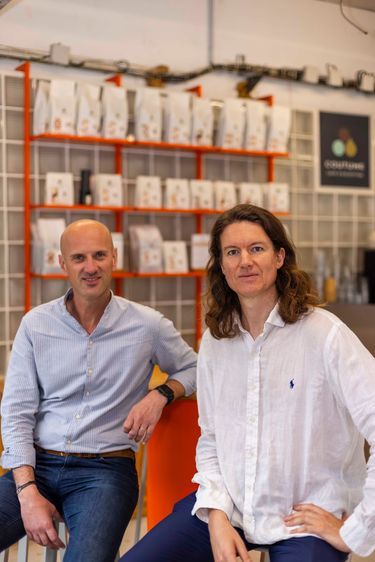
Tom Clark wants to share this science of coffee with his Parisian friends. Once his studies were completed, he returned to France and took the time to mature his project. On March 15, 2011, the Maison Coutume adventure was finally launched, rue de Babylone, in the 7th arrondissement of the capital. “At the time, I arrived with a halogen siphon coffee burner straight from Japan, a glass dripper and an imposing roaster in an environment where everyone only used a percolator,” he recalls with humor. They took me for a crazy chemist! » To attract customers, the Australian – and the few roasters who set up in Paris at the time – stuck to wines, evoking the different coffee grape varieties or harvesting methods. Opposite, customers discover what a “roaster” or a “barista” is, true mixologists of hot drinks, and learn to like their beverage in a way other than in a large bowl in the morning or in the form of espresso. “Even if the truth is that at the beginning, everyone found these new strong coffees, strange… Too concentrated somewhere,” analyzes Tom Clark.
A good salesman, Tom Clark takes the time to guide his customers towards the coffee that suits them – as all his baristas do today – and “to educate their palate”. “Honestly, it took a lot of time. We had to take customers by the hand, provide them with a glass of water to rinse their palate and gain their trust,” he insists. But success comes little by little, as roasters multiply in France and specialty coffee slowly becomes more popular. “The real lever was the fact that many restaurateurs, great chefs and bistros wanted to work with us,” recalls the Australian. They allowed us to reach more people and truly give coffee its nobility.”
Real living spaces around coffee
So much so that today, fifteen years later, Maison Coutume is a well-established chain in France. From its workshop in Romainville, in the Paris suburbs, the company roasts 100 tonnes of coffee beans each year (on a market estimated at 14,000 tonnes) for the chain’s nine cafés, all located in Paris and the inner suburbs. But also different hotel establishments (from small bars to three-star restaurants and palaces), as well as five company cafeterias which have called on them. “At Axa, Landscape and Alterea, there are Coutume cafés within the head office for employees,” explains Rodolphe Aucordier, general director of Maison Coutume. And since good coffee can also be enjoyed at home, the company – now owned by the Labruyère Group – also offers to buy its beans or freshly ground powder (on the Internet, in cafes and in specialized stores) with different ranges to satisfy all consumers, from novice – who will go more towards cocoa notes to expert – who will go more towards floral coffee.
Coutume cafés roast their own coffees in their workshop in Romainville, in the Paris region. © Geraldine Martens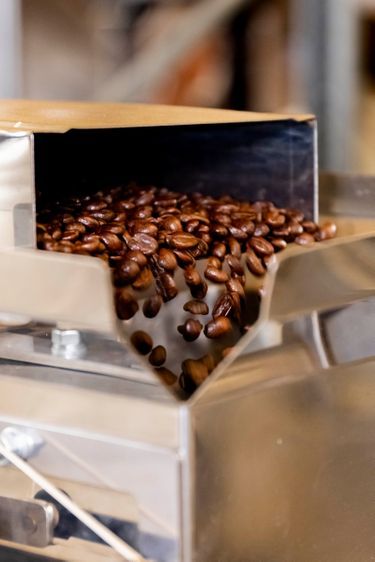
Despite this significant growth, Tom Clark, now accompanied by Rodolphe Aucordier, general director, has managed to preserve what makes up the very DNA of Coutume, the love of a coffee that adapts to our palate. Like mixologists or pastry chefs, its roasters regularly work on developing new blends to offer ever more refined beverages. “While keeping the great classics on the menu, because the French like consistency,” underlines the Australian. In the cafés, the menu of dishes and sweet treats is also reviewed every two months to offer seasonal dishes, always with this vibe Australian made from recipeshealthy“, very popular in recent years. To vary the pleasures, Coutume also regularly calls on pastry chefs for collaborations: for example, Christophe Louie offered them an exclusive panettone this year and Nicolas Paciello a galette des rois. A concept which has been pushed even further at Galeries Lafayette with a permanent association with chef François Daubinet.
7.5 million turnover
Like Australian cafés, Coutumes establishments are designed as real places to live. © Geraldine Martens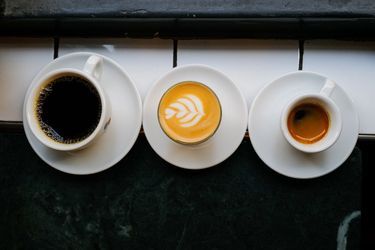
As it has grown, the company has not lost its values. The Maison Coutume teams promise to trace their coffee back to the plot where its grain was grown, participate in the fight against deforestation and are currently helping Colombian farmers to set up a water filtration system on their farm for better use of the resource, among other things. “I really think that today, it is all of this, in addition to our experience, which differentiates us from many of the coffee shops that are flourishing,” analyzes Rodolphe Aucordier. “We have real expertise, know-how, mastery of the supply chain and I have the feeling that we have succeeded in recreating, in our cafes, the atmosphere of old-fashioned PMUs. People stop by for an espresso in the morning before going to work. Sit down to work. Come for lunch. Pass at the end of the day… Excellence that is reflected in the numbers. In 2025, Coutume will achieve a turnover of 7.5 million euros and employ 105 employees. A figure that is clearly growing, but which Rodolphe Aucordier and Tom Clark intend to increase further in the coming years. “We have a roasting capacity of 600 tonnes per year, which gives us plenty of room for improvement,” says the founder. “And above all, we haven’t finished discovering all the coffees in the world, there are still so many flavors to explore!†Enough to make our mouths (or rather coffee) water.


:quality(80)/outremer%2F2019%2F10%2F02%2F5d949c9938fc9_classemiq.jpg "College not threatened: National Education reassures worried parents")