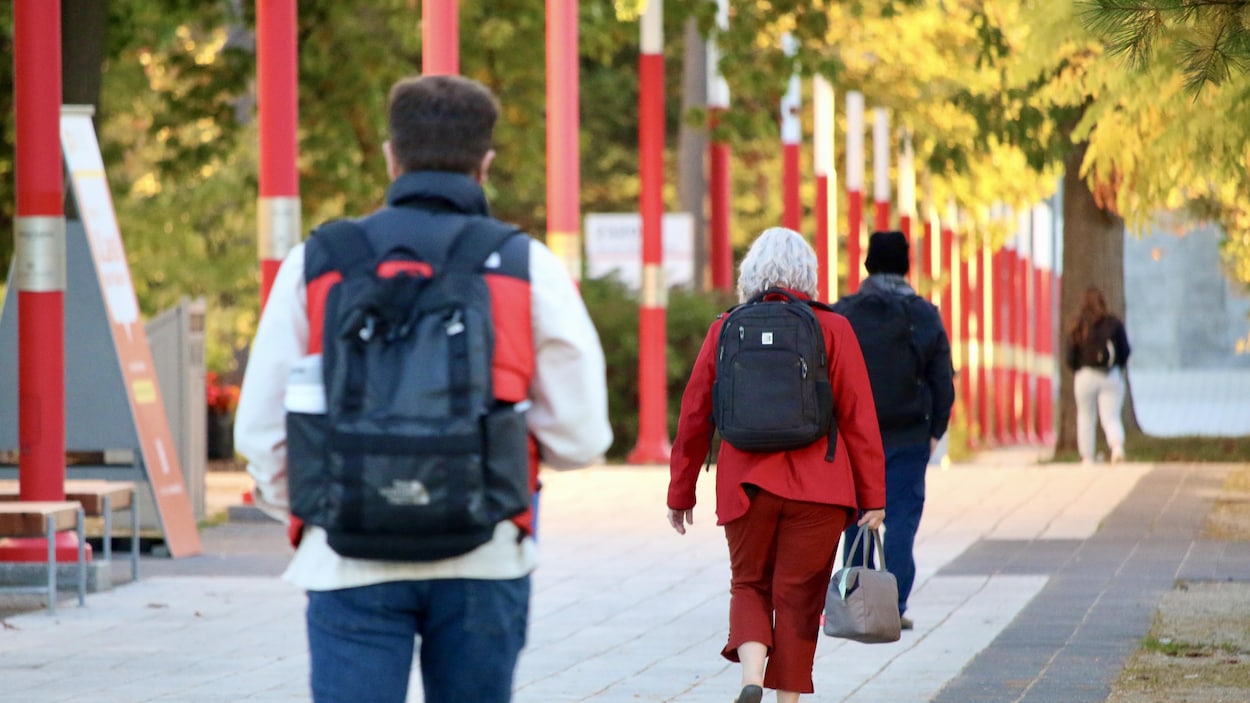
Elke Sorensen was in her second year at Vancouver Island University when she first became involved with campus community radio – an experience that may soon become rarer.
After spending some time finding out about CHLY 101.7 FM before volunteering, the young woman, then 21 years old, says she immediately found herself “in the hot seat” in a live broadcast booth.
Like many beginning students, Ms. Sorensen began by hosting a show devoted to Canadian music, which she says allowed her to make connections locally.
“I really integrated, I got to know the community and I felt more like a citizen of this new city that I now considered my home,” she confided in an interview.
Ms. Sorensen was then able to launch her own bimonthly literary show devoted to Canadian authors, which she was able to use to obtain university credits.
She explains that it gave her the opportunity to combine her passions for radio and literature – and to be heard in that space.
But over time, fewer and fewer people have the chance to tune into these stations, as college radio stations struggle to stay on the air.
Barry Rooke, executive director of the National Association of College and Community Radio, says college radio has reached a critical point and needs help from Ottawa to survive as stations adapt.
He explains that the decline in higher education enrollments, the closure of journalism programs and the optional nature of registration fees in certain schools threaten the existence of university radio stations across Canada.
Memorial University of Newfoundland’s student union voted Wednesday to cut funding for CHMR, according to campus media, in order to fill a deficit.
In the Canadian capital, CHUO 89.1 FM lost its student contribution and was charged rent by the University of Ottawa that it could not afford, according to Mr. Rooke. She stopped her live broadcasts last December.
Stations on the Fanshawe and Algonquin college campuses are also expected to go off the air, with the university programs that supported their operation having been removed.
“The system is under so much pressure (…) that it’s becoming increasingly difficult to raise money and find advertisers locally because everyone has gone digital,†says Rooke.
“Yet in many university and community radio stations, and particularly those in Indigenous communities, they are often the only source of information and news in these spaces—not to mention a place where people can share their passion and learn about media,†he adds.
Amara Sheppard found a new way to express her voice on the University of Guelph station CFRU 93.3 FM after looking for a direct equivalent to the competitive debates she participated in as a youth.
While studying, Amara landed a job at the station and helped revive a music show featuring live concerts and artist interviews. She continued to volunteer for the show after graduating, convinced of its value.
“In many ways, it’s still a bit like the Wild West, in the sense that it’s not as regulated as other forms of media, and it hasn’t really been hit by the AI phenomenon yet,” says Amara Sheppard.
Federal caps on foreign students, first introduced in 2024, have led to mass layoffs and cuts to programs at higher education institutions. As economic pressures mount and enrollment declines, many media programs have also been suspended or consolidated.
In Ontario, the government is considering imposing more optional fees on students through its Supporting Children and Students Act, while student associations nationwide are looking for ways to save money.
The radio stations are asking for help from the federal government
These realities, Mr. Rooke sums up, have created “a perfect storm”. He expects that, without intervention, college radio stations will disappear at an accelerating rate.
Mr. Rooke says it is crucial that the federal government pay attention to a new campaign calling for $30 million in funding per year for university and community radio.
“Of this amount, approximately $25 million would go directly to these 255 radio stations under their license. This therefore represents approximately $95,000 per station,” he says.
This sum is a “dust” in the federal budget, but could completely change the situation for student radio stations, says Etienne Dubuc, general director of CISM, the station of the University of Montreal.
“You know that you have this, every year, it makes things so much easier to have paid employees, for rent costs,” remarks Mr. Dubuc.
In addition to essential spending, this funding would cover initiatives that promote content and increase the visibility of these radio stations.
“With this amount, we can allocate $15,000 to special projects, supervision, training, visibility,” estimates Mr. Dubuc.
This injection of funds would help stabilize the airwaves for some 45 university radio stations, argues Mr. Rooke, and would allow Canada to align with other countries.
“We are truly one of (…) only community radio station networks in the world that is not funded,†Rooke insists.
Mr. Rooke’s association is also organizing a national meeting of college stations later this month, aiming to teach them how to downsize without ceasing programming and diversify their revenues by transforming into larger media hubs.
Scotty Hertz, who hosts a weekly political show for CFRU, said the Guelph-based station found success by providing space for content creation, supporting local music and serving as a professional springboard.
“It’s no longer just a college radio station, it’s a media center,†Mr. Hertz said.
University of British Columbia student Elke Sorensen plans to continue volunteering for CHLY 101.7 FM after she graduates this year. She hopes that local radio can survive, both for the good of its hosts and its listeners.
“There are so many benefits to turning on your radio and listening to local stories told by people you might know,” she observes. The programming is so varied. We hear music from all over the world, but also that of our neighbors, and we feel more involved when we listen to stories that happen in our neighborhood,” adds the student.
– With information from Samira Ait Kaci Ali for The Canadian Press