Â
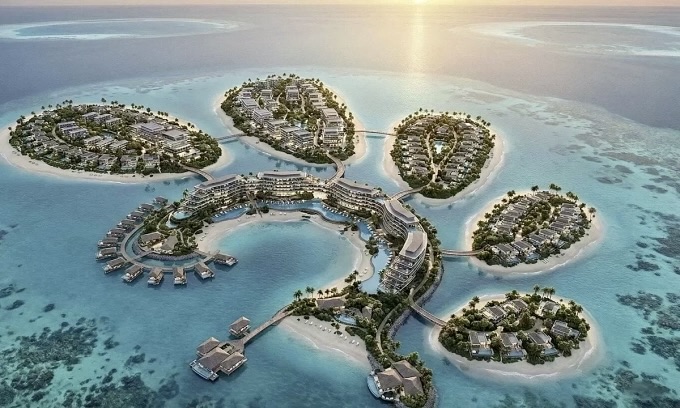
It is a project commensurate with Vietnamese ambitions. The new province of An Giang intends to gain ground… on the sea. Stated objective: to fill in nearly 4,500 hectares and create several artificial islands along its south-west facade, on the Gulf of Thailand.
Â
A colossal project, which would place Vietnam among the most offensive countries in terms of land reclamation in South-East Asia.
Â
The project extends from Phu Quoc – the country’s international tourist showcase – to the coastal towns of Ha Tien and Rach Gia. Four zones, four functions, and the same logic: transforming the coastline into an economic engine.
Â
Phu Quoc en locomotive
Â
At the heart of the system, Phu Quoc. Around the island and the archipelago of Tho Chau, 2,300 hectares must accommodate an integrated complex of international rank: free trade zone, high-end resorts, leisure parks, golf, maritime infrastructure… All with a clear ambition: to make this area the main tourist gateway to southern Vietnam.
Â
The schedule is tight. The authorities want to start work in 2027, the year Phu Quoc will host the APEC summit – an ideal showcase to attract investors and visitors.
Â
A reconstituted province, increased ambitions
Â
Behind this project, a recent administrative reality. An Giang was born in 2025 from the merger of two provinces, An Giang and Kien Giang. A reorganization which today gives it control over a large portion of the strategic southwest coast.
Â
And with it, an ambition: to make tourism and maritime services the pillars of its development.
Â
Rach Gia, future neural center
Â
Second pillar of the project: Rach Gia. Around the provincial capital, 1,100 hectares are to be transformed into an economic and administrative hub of the Mekong Delta. A modern, green city, connected to the islands.
Â
Nothing like a leap into the unknown: Rach Gia had already inaugurated in 1999 the country’s first maritime embankment project.
Â
Culture, ecotourism and logistics
Â
Further north, 900 hectares around Ha Tien and Kien Luong will focus on another register: heritage and ecotourism. Objective: to promote Vietnamese and Khmer heritage through an offer combining culture, well-being and local development.
Â
Finally, the Kien Hai islands, in the open sea, should become a maritime transport hub, a key part of a future coastal tourism corridor.
Â
The environmental challenge in the background
Â
There remains a major question: that of the environmental impact. The provincial president, Ho Van Mung, promises “green” development, with renewable energy and wastewater treatment. But in an already fragile region, between the Mekong delta and marine ecosystems, the bet remains risky.
Â
A clear strategy: attracting investors
Â
An Giang doesn’t want to waste time. The authorities have already given instructions to mobilize investors from the planning phase, without waiting for the start of work.
Â
The message is clear: the province wants to quickly position itself as a major new tourist and economic hub in Southeast Asia. It remains to be seen whether the sea will allow itself to be tamed.
Â
Every week, receive our newsletterGavroche Hebdo. Register by clicking here