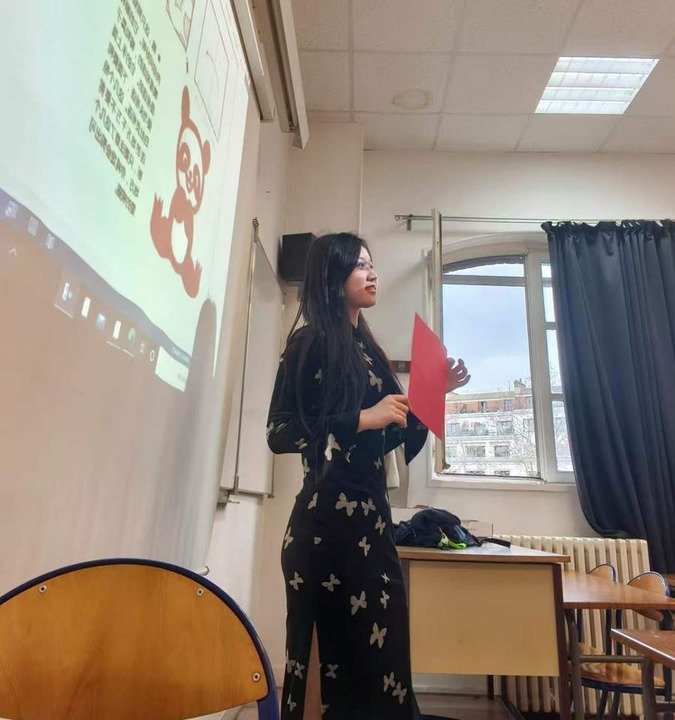
A Chinese teaching assistant in a public high school in Paris, Yu Zhuojia gradually understood that when the language passed from textbooks to daily life and greetings spread from classrooms to corridors, a dialogue between cultures was already discreetly beginning to take place.
PARIS, April 4 (Xinhua) — In the corridors of the high school where Yu Zhuojia teaches, waves of “nihao (Hello)” greet her every time she appears with her textbooks.
Aged 23 and a master’s student at the China International Relations University, Ms. Yu went to France in October 2025 as part of a Sino-French language assistant exchange program to become a Chinese teaching assistant in a public high school in Paris.
“It is the color of the Chinese New Year, red, which symbolizes celebration and good fortune (…) Today, we will learn to cut out the most important Chinese character with our hands, the one which means good fortune,” explains Miss Yu in French.
“During the Spring Festival, people hang this character upside down on their doors, which symbolizes the arrival of good fortune,” she continued, showing how to fold the paper and cut it along the marked lines with scissors to form this auspicious character.
For French students, cutting out Chinese characters with scissors was a new experience. When the first sheet of red paper was delicately unfolded, revealing a “Fu (good fortune)” character, the class exclaimed with joy. Quickly, other creations emerged, each character being unique.
Both a learner of French and a disseminator of Chinese, Miss Yu tells Chinese stories in her class while strengthening Sino-French cultural exchange through her daily teaching.
What touches Miss Yu most is how Chinese has become a bridge for her students to express their feelings. While one day she asked her students to describe a person in the classroom using the Chinese words they had learned, one student described her like this: “My Chinese teacher is Miss Yu. She is Chinese. She is young. She has black and very long hair. She likes to wear qipaos (traditional Chinese dress). She teaches us Chinese (…) She is very kind and very beautiful.” Although the sentences were not yet entirely coherent, they formed an authentic portrait of a person who was not only a “teacher” but also a warm cultural ambassador.
Miss Yu gradually understood that when language passed from school textbooks to daily life and greetings spread from classrooms to corridors, a dialogue between cultures was already discreetly beginning to take place. “These small, sincere moments, like the first green shoots that appear on the branches at the beginning of spring, may be discreet, but they reveal the sound of growth (…) For educators, these are the most precious echoes, which signify that the seeds of culture have taken root, that cross-cultural exchange really takes place in young minds,” describes Ms. Yu.
When Ms. Yu observes her students’ first steps in learning Chinese, it always reminds her of her own beginnings in learning French at the age of 18: the same curiosity, the same awkwardness and the same gleam in her eyes. “Today, our roles are reversed: I use French to open the doors to the Chinese world for them, just as my French teacher once opened a window to the French world for me,” she explains.â–