Under the millenary walls of prehistoric caves, a major scientific breakthrough is shaking up certainties. Thanks to unprecedented techniques, researchers reveal carbon in ancient pigments, opening a new era for dating cave art with unprecedented precision today.
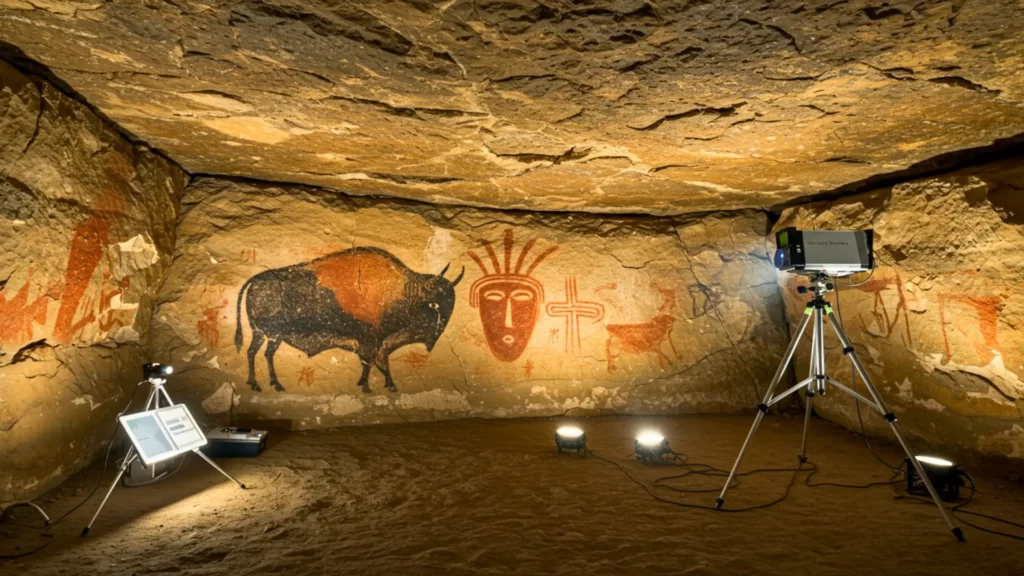
An non-invasive scientific device analyzing ancient cave paintings to reveal their composition and refine their dating – DailyGeekShow.com / Image Illustration
A major scientific discovery reveals the presence of carbon in prehistoric pigments
For decades, specialists considered cave paintings impossible to date directly. Indeed, black pigments seemed to consist solely of mineral oxides, which ruled out any reliable carbon-14 analysis. This major scientific limitation greatly hindered the chronological understanding of ancient artworks.
Today, the combined use of Raman microspectrometry and hyperspectral imaging radically changes the game. These techniques examine matter without altering the drawings. They then reveal the discreet but very real presence of charcoal in certain figures, overturning an established scientific consensus.
A study by CNRS published in PNAS validates a new reliable dating method for paintings
In this context, researchers publish their work in the prestigious journal PNAS in March 2026. They analyze figures from the Font-de-Gaume cave, including two black motifs. Thanks to these non-invasive tools, they study a bison and a mask with remarkable unprecedented precision.
Furthermore, the scientists demonstrate that the detected carbon does not come from modern contaminations. Its homogeneous distribution on the traces confirms its ancient origin. Thus, this decisive scientific validation establishes for the first time the possibility of reliable direct dating.
Unprecedented dating clarifies the periods of creation and reveals a complex artistic history
The researchers date the bison between 13,461 and 13,162 years calBP (calendar years before present). This estimation places it slightly later than expected, adjusting the chronology of animal representations throughout the region.
As for the mask, it reveals an even more fascinating complexity. Several areas show different datings, ranging from approximately 16,000 to 8,600 years before present. This superposition of periods indicates successive interventions and prolonged occupancy.
A method that opens up new perspectives for understanding societies and prehistoric art
This approach now opens up unprecedented perspectives for the study of other major sites. For example, famous caves could finally be accurately dated, especially major emblematic sites whose chronology remained uncertain.
In parallel, these analyses provide a finer reading of the techniques used. Researchers better identify material choices and pigment blends, highlighting valuable technical clues about prehistoric know-how.
By revealing the presence of carbon where no one expected it, this discovery marks a turning point. It provides a new scientific tool to decipher symbolic behaviors and better understand artistic evolution over millennia.