Complexity, an enemy of action
Biodiversity suffers from a problem that climate does not have. It is invisible. Diffuse. Impossible to summarize in a degree, a curve, a date.
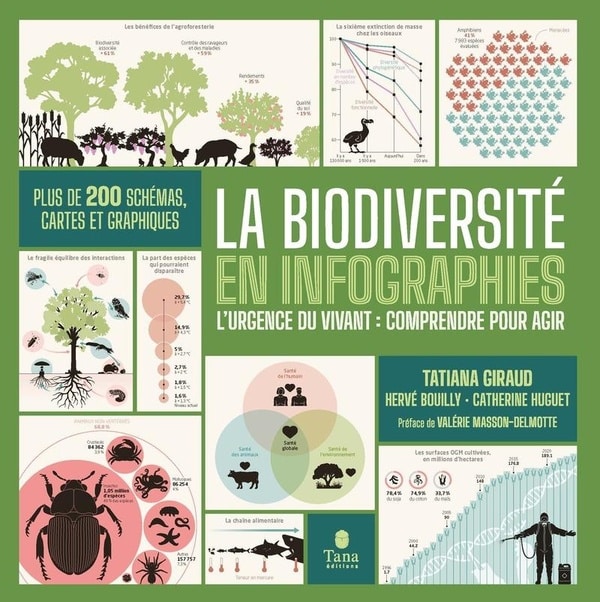
Tatiana Giraud, research director at CNRS and member of the Academy of Sciences, decided to tackle it head-on. Her book, Biodiversity in infographics, the urgency of life: understand to act, published on March 12, 2026, by Tana Editions, is an ambitious attempt: to make the complexity of life accessible to everyone, without betraying it.
We know bees. We ignore what they depend on. We plant trees without knowing that three-quarters of them do not grow without symbiotic fungi. We concrete without realizing that we are removing the natural buffers that absorb floods.
“Ecology is about interactions between hundreds, thousands of species, with beneficial relationships and antagonistic relationships,” explains Tatiana Giraud for La Relève et La Peste.
This complexity is a political problem as much as a scientific one. What we do not understand, we do not defend. What we do not defend, we let die.
The project stems from her courses at the Collège de France, between 2020 and 2021. Twelve years of teaching at Polytechnique taught her to read faces. Infographics are not an aesthetic choice. It is an educational conviction. Showing the cascade of effects caused by the disappearance of the wolf in Yellowstone, overabundant herbivores, disappeared trees, departing beavers, dried-up ponds, lost amphibians, takes pages of text. A diagram says it all at a glance.
Science under attack
The context in which this book appears is not insignificant. In the United States, research funding is being cut by decree. Environmental data is disappearing from government websites. Researchers are left without positions overnight.
Tatiana Giraud closely follows this. Some of her former American post-doctoral students are directly affected. “Some are really in very difficult personal situations. It’s terrible, and we get the feeling that this movement is also happening in France, for now on a smaller scale.”
In France, the mechanism is different, but the direction is worrying. The voices of experts are increasingly challenged in the public space. Some media outlets put a researcher and a contradictor on an equal footing without data or protocol. Opinion overrides evidence.
“We put an ultra-expert scientist, who knows established data with rigorous protocols, face to face with someone who says the opposite without any argument or proof, and present it as equivalent.” There is no ambiguity: “Science is not an opinion.”
The mechanism is established. “As soon as we express a message that doesn’t please some, we are immediately labeled as militant, which allows the proposition to be discredited without addressing the substance.” The label is enough. It avoids having to respond to the content.
For now, Tatiana Giraud chooses to defend rigor as a shield, evidence as an argument, and pedagogy as a strategy. However, she understands those who choose a different path.
“I fully understand colleagues, such as Scientists in Rebellion, who consider that calmly stating things with scientific evidence is not enough, and who choose other stronger forms of action.”
The diversity of stances within the scientific community is not a weakness. It is a diverse response to a collective threat.
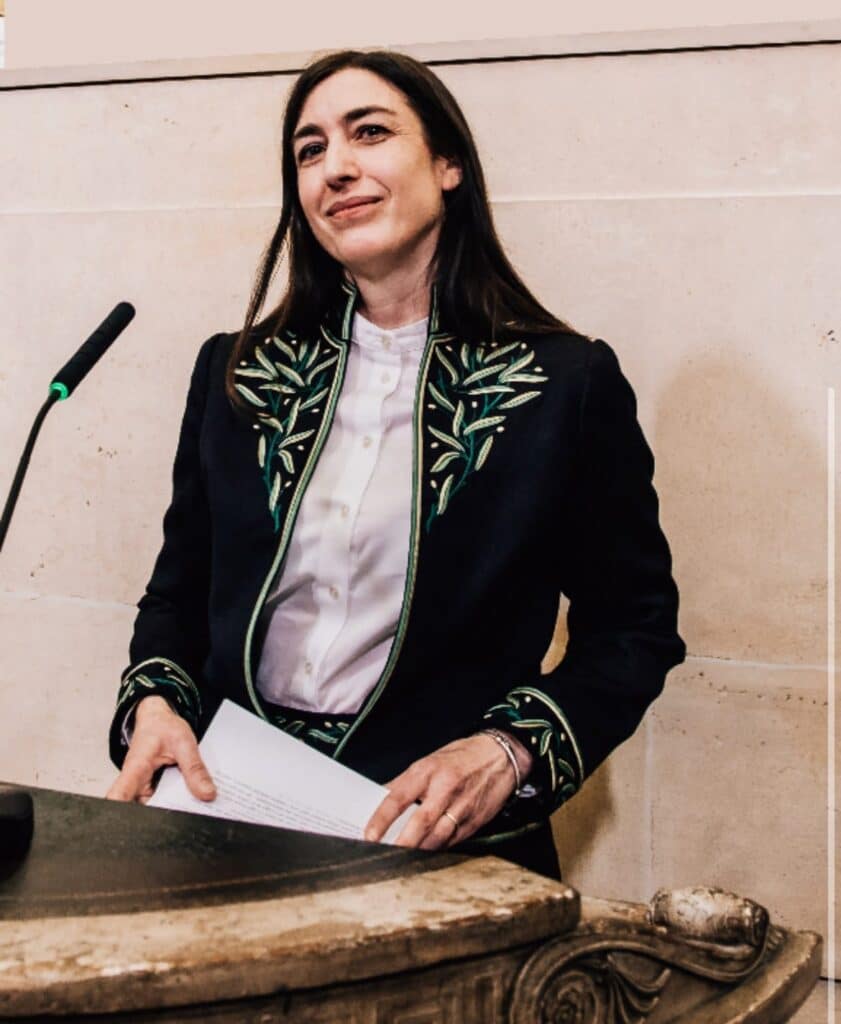
Tatiana Giraud – Wikimedia Commons
From science to democracy
With the Academy of Sciences, Tatiana Giraud supported a text inspired by a Stanford forum, published notably in Libération. The message is clear: attacking science is attacking democracy.
“If we start saying that there is no method to establish truth, no protocol to seek it, then we can say anything, and democracy itself is in danger.”
Without shared truth, there can be no debate. Without debate, there is no legitimate collective decision-making. Misinformation about biodiversity is not just an environmental problem. It weakens the foundation on which all democratic life rests.
“Many solutions, especially technological ones, that are often imagined as answers, are actually inadequate and mainly serve as an excuse not to act.”
Understanding what biodiversity truly is also means learning to resist these facade discourses.
“It is a question of the common good. People should understand that it is in their interest to protect their environment and health, in the face of the financial interests of a minority benefitting from the destruction of life.”
Life is collapsing. The science that studies it is under pressure. Tatiana Giraud is betting that understanding remains, nevertheless, the first act of resistance.
Staying informed with independent and free media is a necessary guarantee for a democratic society. We offer daily articles for free access because we believe that information should be free for everyone. If you want to support us, the sale of our books finances our freedom.