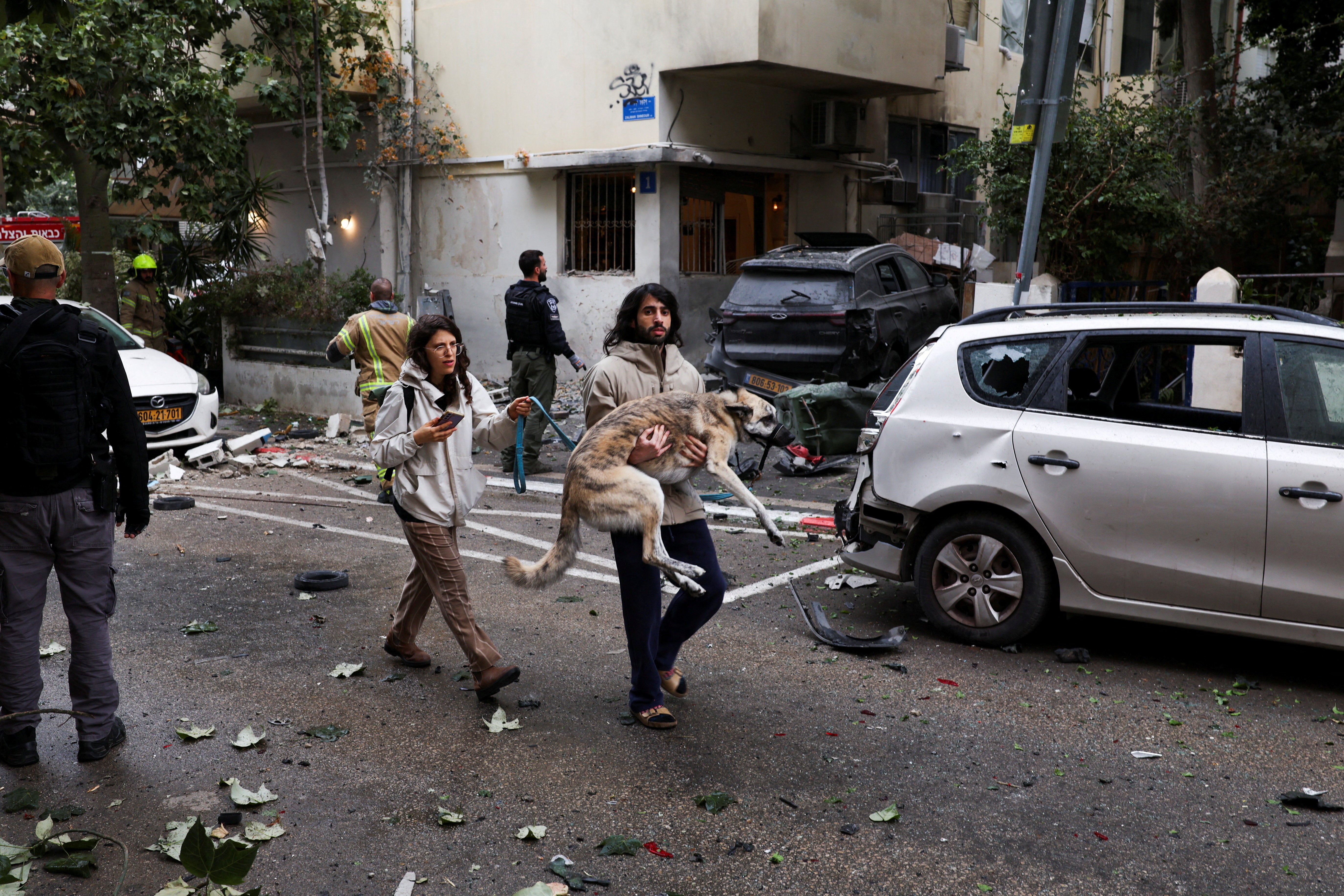
The Iran launched missiles across the Middle East on Tuesday in response to new Israeli strikes on its capital Tehran, just hours after Israeli Prime Minister Benjamin Netanyahu declared that more than half of its military objectives had been achieved.
“It is certain that half of the journey has been completed. But I do not want to set a timeline,” Mr. Netanyahu told the American television channel Newsmax.
Sirens sounded in Jerusalem when the Israeli army announced it had retaliated against new Iranian missiles, while local Iranian media reported new explosions in Tehran causing “power outages in some parts” of the capital.
Iranian media also reported that initial investigations indicated strikes in central Iran had hit some “military sites.”
New Iranian attacks on Gulf countries
Iran fired new missiles at Gulf countries. Debris from intercepted projectiles injured four people in Dubai, while a Kuwaiti oil tanker caught fire in the city’s port.
In Saudi Arabia, authorities said they intercepted eight ballistic missiles, shortly after the top Iranian diplomat called on Riyadh to “eject American forces.”
Iran’s foreign minister Abbas Araghchi stressed that Tehran’s attacks on Arab Gulf states only targeted American forces, even though civilian targets were hit across the region.
M. Araghchi’s comments to Saudi Arabia come as growing anger from Arab Gulf states encourages them to push the United States to continue the war.
“Iran respects the Kingdom of Saudi Arabia and considers it a fraternal nation,” he wrote on X, sharing a photo allegedly showing damage to an American aircraft at the Prince Sultan Air Base in the kingdom. “Our operations target enemy aggressors who have no respect for Arabs or Iranians and cannot provide any security. … It is high time to eject American forces.”
Trump claims negotiations continue despite Iran’s denial
US President Donald Trump claimed to be in direct contact with senior Iranian officials. On Monday, he said the US was negotiating with the Iranian parliament speaker, Mohammad Bagher Qalibaf.
The former commander of the Revolutionary Guards had been presented as Washington’s negotiating partner, but he denied that Iran was in talks with the US and said discussions facilitated by Pakistan were only a cover for US troop deployments.
Iran’s foreign ministry spokesman Esmaeil Baghaei once again denied the existence of negotiations, stating the US only sent a discussion request through intermediaries, including Pakistan.
According to Mr. Baghaei, Tehran received a 15-point proposal from the Trump administration containing “excessive, unrealistic, and irrational demands,” but there were no direct discussions.
Mr. Qalibaf, the parliament speaker with whom Mr. Trump claims to be negotiating, said Iranian forces “were waiting for the arrival of American troops on the ground to set them on fire and punish their regional partners forever,” according to state media reports.
New threats against Iranian power plants
On Monday, Mr. Trump again threatened to destroy Iran’s energy resources and other vital infrastructure on a large scale, including desalination plants, if an agreement to end the war with Tehran was not reached “soon.”
He threatened to deploy ground troops to seize essential oil infrastructure on Kharg Island, an operation that experts say would endanger American lives and may not end the war.
“Sending troops on the ground could be the most psychologically convincing way to strike at Iran,” said Michael Eisenstadt, a former US military analyst who now heads the Military Studies and Security Program at the Washington Institute for Near East Policy.
“On the other hand, you are putting your own troops in danger,” he added. “The region is not very far from the continent. They can potentially rain a lot of destruction on the area, if they are ready to inflict damage on their own infrastructure.”
A US Navy ship carrying about 2,500 marines recently arrived in the Middle East, while at least 1,000 soldiers from the 82nd Airborne Division are expected soon. Another 2,500 marines are being deployed from California.
The Trump administration has not specified the roles of these troops, but the 82nd Airborne Division is trained to parachute into hostile or contested territory to secure closed areas and airfields.