The decision to cancel the traditional Palm Sunday procession was announced by the Church itself. Nevertheless, as in the time of covid, the Latin Patriarch, Cardinal Pizzaballa and the Custos of the Holy Land, Brother Francesco Ielpo, agreed to spend a time of prayer on the slopes of the Mount of Olives.
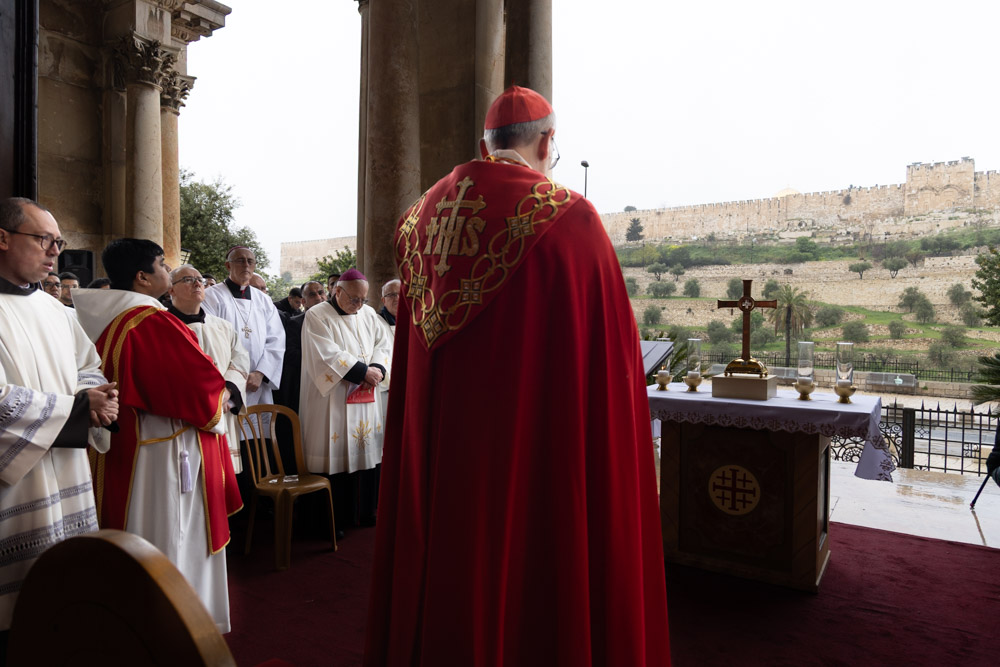
The rain having entered the program, it was Gethsemane rather than the sanctuary of Dominus Flevit, which hosted the small assembly. Some brothers of the Custody were joined by some priests of the Latin Patriarchate and representatives of the four Latin nations France, Spain, Italy and Belgium.
Read also →ÂAgreement for reduced number of Holy Week celebrations
The ceremony began with… a missile alert… requiring everyone to take cover.
Once the restriction was lifted, it was under the portico of the Basilica of the Agony that prayer continued in the presence of the true cross in the reliquary of the Custody.
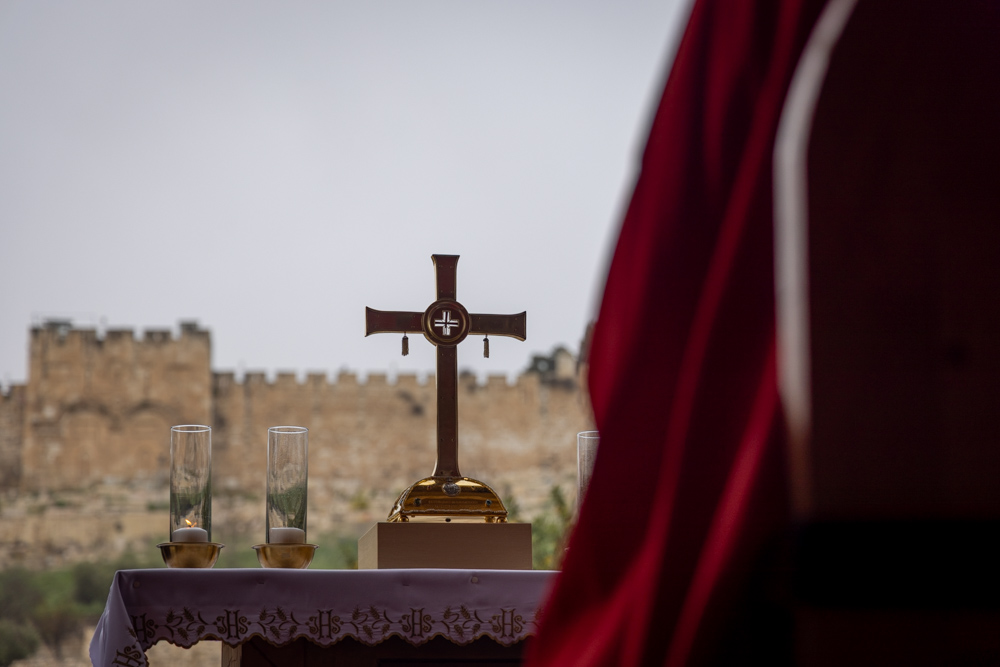
In the context of the war which devastated all the inhabitants but particularly the Christian presence and the events of the morning which had seen the patriarch and the custos forbidden to enter the basilica, the Cardinal’s meditation resonated intensely.
We reproduce it in its entirety, because it is definitely worth reading and receiving.
Dear brothers and sisters in Christ,
may the Lord give you peace.Â
We are here in Gethsemane, the place where Jesus, having reached the climax of his pilgrimage to Jerusalem, stopped and wept. His gaze did not rest on the majestic walls nor on the splendor of the Temple; he penetrated the heart of the city he loved, and there he saw its difficulty in recognizing the time of grace.
On this Palm Sunday afternoon, we gather without a procession, without waving branches in the streets. This absence is not only a question of form. It was the war that interrupted our festive journey, making even the simple joy of following our King difficult.
Our brothers and sisters of the Holy Land cannot fill the streets today or unite their voices in the festive procession. Their absence is not in vain before the Lord. He does not seek the triumphal roads, but he enters where the door remains ajar, where daily fidelity becomes the bread of each day.
We are certain that the Crucified and the Resurrected never cease to walk among us: even when the road is blocked, he remains in the hearts of those who have not stopped following him. And it is precisely in this imposed silence that the liturgy becomes more authentic. The cry “Hosanna” has not no need for branches to rise to heaven, and faith does not waver when external rites are stripped away.
Read also →ÂChurches in Jerusalem encourage their faithful to stand firm
Today, Jesus weeps once again over Jerusalem. He cries over this city, which remains a sign of both hope and pain, of grace and suffering. He cries on this Holy Land, still incapable of recognizing the gift of peace. He cries for all the victims of a war that seems endless: for the divided families, for the shattered hopes. But the tears of Jesus are never sterile: they open our eyes, challenge us and reveal the truth.
The Gospel of the Passion that we have just heard shows us how Jerusalem responded to this love. We heard the betrayal of Judas, the denial of Peter, the silence of Pilate and the cries of the crowd demanding the cross. We saw the Lord stripped, crowned with thorns, nailed between two criminals, mocked by passers-by. The darkness seems to have the last word.
⬇︎ Le replay de la célébration de bénédiction de la ville depuis Gethsémani ⬇︎
And yet, a luminous and uninterrupted thread runs through these pages: Jesus remains faithful until the end. He places his spirit in the hands of the Father; the earth trembles, the rocks split, and in this dramatic moment, the centurion proclaims: “Truly, this was the Son of God! » (Mt 27:54).
This detail continues to concern us today. The centurion is a soldier, a man shaped by the logic of force, by a power that imposes itself. By his profession, he measures success by domination, by victory, by control.
And yet, faced with this man nailed to the cross – faced with a love that does not defend itself, faced with a fidelity which does not shrink even in the face of death – his criteria collapse. He discovers that true power lies neither in violence nor in the sword that kills, but in a life given freely.
And so he makes the highest confession: this man is the Son of God. Just when death seems to triumph, truth is revealed, love is manifested and salvation is accomplished.
Today, when war seems to stifle every word of peace, here – where Jesus wept – we can hear that same confession resounding. The ultimate word of God is the empty tomb. It is the Lord who precedes the disciples into Galilee and who also precedes us, leading us towards a peace which is not an illusion, but the fruit of the cross.
“If only you had recognized today what gives peace” (Luke 19:42).
The peace that Jesus offers is not a fragile agreement between enemies, but a peace born of the cross – a peace that comes from a God who gives himself totally and needs neither force nor weapons. This is the paradox that we are called to welcome today.
Jerusalem, the Holy Land, is not only a geographical location; it is the beating heart of our faith. Each stone speaks of salvation; each hill carries the memory of the God who chose to be close. To live faith on this earth is to accept the contradiction it embodies: the place of resurrection is also that of Calvary; the place of God’s embrace is still marked by too much hatred.
Yet, from this holy place, we learn to look at the city with the eyes of Christ. We learn to cry with him, but also to hope with him. For this same Jerusalem which rejected the Prince of Peace was also witness to the empty tomb. War will not erase the resurrection. Sorrow will not extinguish hope.
Today, we do not carry branches in procession. Instead, we carry the cross – a cross that is not an unnecessary burden, but the source of true peace. We do not wave olive branches; rather, we choose to become artisans of reconciliation, through every gesture, every word, every relationship.Â
Brothers and sisters, on this earth that continues to wait for peace, we are called to be witnesses to a love that never gives up. May our path of faith, even today, be a path of hope. And may our lives, even in the heart of present trials, bring the love of Christ and his light wherever darkness seems to reign.
Amen.Â