The tropical cyclone Narelle falls into a rare category of cyclones capable of maintaining itself for more than a week, or even longer, while retaining an organized structure. In fact, many tropical cyclones have a shorter lifespan because they quickly make landfall in Australia, which weakens them. Or, the systems encounter unfavorable conditions, such as cooler waters.
However, Narelle has successfully evolved in very warm waters, and alternated between maritime and terrestrial phases in its trajectory, allowing the system to persist in duration. As a reminder, the cyclone intensified to category 4 north of Queensland between Thursday, March 19 and Friday, March 20, with powerful gusts exceeding 200 km/h.
This cyclone later moved westward into the Gulf of Carpentaria, before making landfall a second time in northwestern Australia, between Darwin and Broome, causing torrential rains resulting in floods and inundations. Then, this Friday, the cyclone strengthens and makes landfall a third time in the far west of the country, intensifying back to category 4. This weekend, it will notably affect the Perth area with deadly gusts and heavy rains.
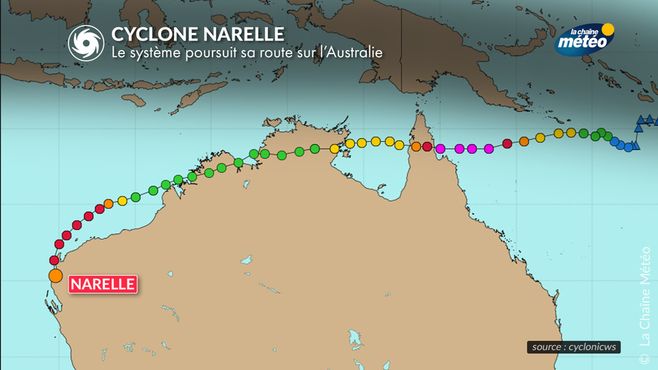
Trajectory of cyclone Narelle in Australia © The Weather Channel / Weather Consult
Such a durable cyclone, with an almost circular trajectory around the country, and with multiple successive impacts on Australia, had not been observed in this region for 21 years. The system will then progress southward, gradually dissipating.